The cute little Mimy was the most basic of several half-frame Yashica models. Half-frame cameras (18x24mm, half the size of the 35mm format but using the same film) had a brief spell of popularity in the mid 1960s; other examples on this site are the Canon Demi and Minolta Repo. The Mimy was essentially a dressed-down version of the Yashica 72-E (see below). Like the 72-E it was a viewfinder camera but with fixed focus and without manual exposure controls. Due to the short focal length of the lens (28mm, equivalent to about 40mm on full frame) the depth of field was relatively large, which was why Yashica could get away with a fixed focus lens. The focus distance was set at 3m, so one needed to stop down to at least f/11 to get infinity focus. Thus, this camera was more practical for street photography.
The Mimy was equipped with auto exposure: upon pushing the release button half-way down the bottom left corner of the viewfinder frame would change from red to yellow if light was sufficient. The camera could also run in aperture-priority mode, although it appears this was mainly meant to be used with flash, as the lightmeter window did not clearly indicate if the exposure was fine. Film was advanced by means of a small thumb wheel at the bottom of the camera. The Mimy was succeeded by the Mimy-S, which had a redesigned viewfinder area and a lens that could be focussed.
The Yashica Mimy is a lovely half-frame 35mm camera from the early 1960s. The half-frame picture format is 18×24 mm rather than the 24x36mm of standard 35mm. This means that you get double the amount of shots out of a standard film roll (48 photos out of a 24-exposure roll or 72 out of a 36-exposure roll); this of course means your photos will have more noticable film grain.
This camera has a fully automatic exposure mode powered by a selenium cell (no battery required). In addition, you can manually pick an f-stop (use this mode for flash photography). The lens is a nice fixed focus Yashinon 28mm f2.8; At f.28, everything from 2.39m-4m will be in focus; by f11 everything from 1.5m to infinity will be in focus (see the manual linked below for a full depth of field chart).
The Diana Mini Camera is a plastic box camera that utilizes 35mm film, and is a part of a long line of lomographic cameras known for taking photos vibrant in color with deep saturation and vignettes shot through a plastic lens. It is capable of taking 72 exposures per roll of film in "half-frame" mode and 36 exposures in "square" mode. It can also take multiple exposures. Modeled after the original Diana camera, the Diana Mini is one of many reproductions and re-imaginings of the Diana camera by the Austria-based company, Lomographische AG FN: FN 134784. The Diana Mini is one of several new production versions of the Diana camera currently available as the Diana+ series, produced by Lomography.
The Diana Mini 35mm Camera from Lomography is the ultra-compact, version of the Diana F+ camera. This plastic camera with a wide angle lens allows users to get in close or choose between any of four focal distances. It has exposure settings: 'Sunny', 'Cloudy', or 'B'. The Mini has two formats, 36 square pictures or 72 half-frame pictures on one roll of 35mm film. Plus, users can swap between formats on the same roll with the flick of a button. The Diana Mini, to enhance creative possibilities, is ready and able to create multiple exposures. With the Diana Mini long exposures are easy thanks to the 'B' setting, tripod mount and cable release attachment - a Diana first.
The Diana Mini came about after the reincarnation of the original Diana camera, the Diana F+ Camera, released in 2007. The Diana Mini brought with it the ability of the photographer to choose between the half-frame format that allows the user to shoot twice the amount of exposures for any 35mm film roll, or the less common square format that allows for 24x24mm exposures to be shot on 35mm film.
Uses all kinds of 35mm film – it can take up to 72 shots in half-frame mode per 1 roll of 36 exposure film
Shoots two film formats: square and rectangular half-frames
Multiple exposure available
B mode for long exposures
Cable release attachment and Tripod mount
Compatible with the Diana F+ Flash
The Canon Dial 35 was an unconventional half-frame 35mm camera with clockwork automatic film advance. It was made in Japan by Canon from November 1963. The Dial 35 was also sold as the Bell & Howell Dial 35.
The body had an unusual "portrait" format rectangular shape, with a short, wide-diameter lens barrel containing the CdS meter photocells window around the 28mm lens. Rotating the lens barrel set the speed of the Seikosha shutter; the aperture was set automatically. A button below the viewfinder could be pulled out to give manual aperture control, for manual exposure settings or flash. Film speed was set on a scale around the meter window.
Focus was set on a lever around the top of the lens barrel, with a display inside the viewfinder.
There was a cylindrical handle at the bottom, which also wound the clockwork mechanism. On the (users) left is an accessory shoe. The film ran vertically, from the cassette at the top to the take-up spool at the bottom, giving a landscape-format 24×18mm frame when the camera is upright.
Manufacturer: Canon
Introduced: Nov 1963
Film: 35mm 24×18mm Half-frame
Shutter: Seikosha 1/30–1/250s, with Flash sync
Film speed: 8–500 ASA
Lens: Canon SE 28mm f/2.8 (5 elements in 3 groups), focus down to 0.8m
The GOLDEN HALF is a 35mm half-format plastic camera. I discovered it recently while browsing through some alternative camera sites, and since it takes odd 18x24mm pictures (that’s two in the space of a “normal” 24x36mm negative), I decided I had to have it.
After 4 weeks and several rolls of film, here’s my two cents.
I discovered this camera at the London Photographer’s Gallery, experts and stockists for plenty of Holga & Co schnick-schnack. At £35 not bad for Central London prices (hey, it even comes with a film in the box).
Rumour has it that the Golden Half was produced for a project by/for Ina Babylon and a book called “Life as a Golden Half”. I’m quoting from memory here, as I’ve not seen a copy of this book or found anything about this project. The name Ina Babylon may or may not refer to an actual person, it certainly is associated with the Superheadz Website, aka the makers of this rubberized pocket gadget. The entire site is in Japanese, a language fascinating yet very much a mystery to me.
Luckily though, the manual is in English and even funny at times.
In a nutshell it explains the features of the camera and it all comes in a shiny plastic box, stating that you can take twice the amount of ordinary 35mm pictures (48 on a 24 roll, 72 on a 36 roll – you get the picture). It achieves this by taking a fairly small picture on a piece of film, comparable to that of 35mm motion picture cameras.
This idea isn’t new, and in fact goes way back. Had it not been for the ultimate source of all knowledge Paul Weston, I’d never have known. Apparently, Olympus made an entire SLR system around half format called the Pen F series. Very small cameras for the time (we’re talking the late 60ies here), and a whole arsenal of lenses was available. Paul even owned such a camera and says it took cracking pictures – until someone stole it from him in a changing room in Australia.
The main oddity of half-frame or half-format is that while holding the camera landscape, you’re actually taking a portrait picture, and vice versa. It’s like using the 645 gate with a Holga. It’s odd, but you get used to it quickly.
The other side effect of half-format of course is the image quality.
Paul remembers that for 6×4″ prints you don’t see a difference, but of course if you go bigger than that, grain starts becoming very visible. That’s not necessarily a bad thing; I for one am immediately thinking of funky black and white effects and overdeveloped HP5 film for an extra scoop of spookiness (see examples).
What’s in the Box
The camera comes in a choice of black or blue. Mine is black with a rubberised finish – like some versions of the Lomography Sumpersampler.
1x Golden Half camera
1x hand strap
1x 400 ASA Kodak film (in a matching Golden Half box)
1x Lens Cap
1x tiny Manual, about the size of a 35mm film box. Cute!
There’s an inscription on the back, explaining the basic concept. It finishes with “So throw away your book and why don’t you go out”. I love it already!
The Golden Half camera takes 35mm film and transforms each frame into 2 individual standard vertical format photos - one right next to the other, thus doubling the number of pictures your roll will take. For example, you put a roll of 36 exposures into the Golden Half, you'll actually get 72 pictures. Aside from increasing your shots, this miniature sized camera allows your creative self to make diptychs and juxtapositions with the images you shoot. The Golden Half is designed to be small enough to fit into most pockets, and light enough to be easy to carry around so that you will never again miss an opportunity to create a great picture. The hotshoe it's equipped with means that with the attachment of a flash, you're in business to shoot in all kinds of light. The Golden Half features two apertures: f/11 for sunny skies or when using flash, and f/8.5 for cloudier times.
he Golden Half features a very wide lens, 22mm as the manual states. That’s probably the actual focal length of the lens, which means at a smaller frame size, this would appear even wider. A quick glance through the viewfinder confirms this – without fisheye distortion, you can capture A LOT at a time, making this an ideal tool of candid street photography. Cartier-Bresson would have loved it. Be careful though that you don’t go up too close, minimum focusing distance is 1.5 meters (60 inches) according to the manual. In reality, I’ve not had anything out of focus though.
At the same time, it’s tiny compared to other film cameras. Imagine a stack of 5 Mini Discs maybe… or to say it with numbers, 9.5 x 7 x 3.5cm (that’s 3.5 x 2.5 x 1 inch) at only 84 grams not including a film (which would weigh about 20 grams). It fits neatly in the palm of my hand.
Apart from the obvious shutter button next to the viewfinder (top middle), the camera features an accurate film counter which counts all the way over 72. That’s a magical sight on a film camera, especially when you’re used to changing a roll every 12 pictures. It’s got a loupe to magnify the tiny numbers on what must be a white plastic wheel on the inside.
The film is wound to the next exposure with a plastic cog wheel, like we know and love from disposable cameras. You open the camera with a switch on the left, and there’s a little plastic crank on the bottom to rewind the film. All in all, it’s got a pretty sturdy feel to it.
On the front we find a switch for two real apertures: f8 for cloudy and f11 for sunny days (give or take 5% says the manual). I say “real apertures” here because you can actually see the hole changing, unlike on Holga cameras, where the aperture switch doesn’t work out of the box. There’s a third setting here with a flash symbol, which switches to f11 again – bringing us to yet another exciting feature: the Flash Hotshoe.
Even though it’s positioned a bit odd at the top left hand side of the camera, the Golden Half features a proud hotshoe for an external flashgun! I’ve tested this with a Canon 580 EX-II speedlite, and it works a treat. The flash fires in any of the three aperture positions, no matter if you choose flash, cloudy or sunny. Sweet!
To round it all off, there’s a tripod mount on the bottom of the camera. This might come in handy not so much for actual tripod shots, but more for accessory attachments. Sadly, there’s no bulb feature – but hey, when have I used that last?
Under the Hood
Let’s take a look at the insides of this little plastic gem.
What strikes me at first glance is that the film winds from right to left, not from left to right as is usually the case. It certainly doesn’t matter, but it’s a fact I’ve never thought about. All cameras I’ve worked with wound the other way round. Interesting.
You don’t have to lift the crank on the bottom, the film canister just fits in without mechanical shenanigans. The take-up spook is fairly thick, which is nice for the film. There’s a slit in the spool into which you can insert the film, which makes loading the camera very easy.
The bottom sprocket is used to crank up the leaf shutter, which must be a very thin plastic plate. The manual states that it fires at 1/100th of a second. There’s a thin clear plastic sheet in front of the shutter, possibly for protection. No pressure plate, just simple grooves to hold the film in place.
As for the lens, it certainly looks like it’s made from pure plastic. I’ve just seen some scanned results, and it looks like at f8 there’s a good sweet spot of about 50% in the middle, with fairly blurred edges (depending on the shot). Reminds me of the Holga look through and through. I’m sure at f11 we’d see more of the sweet spot, and a less blurred edge.
The Canon Dial 35 was an unconventional half-frame 35mm camera with clockwork automatic film advance. It was made in Japan by Canon from November 1963. The Dial 35 was also sold as the Bell & Howell Dial 35.
The body had an unusual "portrait" format rectangular shape, with a short, wide-diameter lens barrel containing the CdS meter photocells window around the 28mm lens. Rotating the lens barrel set the speed of the Seikosha shutter; the aperture was set automatically. A button below the viewfinder could be pulled out to give manual aperture control, for manual exposure settings or flash. Film speed was set on a scale around the meter window.
Focus was set on a lever around the top of the lens barrel, with a display inside the viewfinder.
There was a cylindrical handle at the bottom, which also wound the clockwork mechanism. On the (users) left is an accessory shoe. The film ran vertically, from the cassette at the top to the take-up spool at the bottom, giving a landscape-format 24×18mm frame when the camera is upright.
Dial 35-2
The 35-2 has a black nameplate at the top in place of the engraved name and a longer-lasting clockwork motor. Speed range is increased to 1000ASA, the meter uses a different battery and a hot shoe is added.
Manufacturer: Canon
Introduced: Nov 1963
Film: 35mm 24×18mm Half-frame
Shutter: Seikosha 1/30–1/250s, with Flash sync
Film speed: 8–500 or 1000 ASA
Lens: Canon SE 28mm f/2.8 (5 elements in 3 groups), focus down to 0.8m
Chaika (Russian: Чайка) was a series of Soviet 35mm half-frame cameras produced by BELOMO from 1965 to 1974. The name came from call sign of the first woman in space - Valentina Tereshkova. Over 2 million Chaika cameras were produced. All models of the Chaika cameras have metal case.
Chaika cameras share the following basic specifications:
Film used — 35-mm in standard cassette (135 type)
Frame size — 18×24 mm
Lens — Industar-69 (Tessar-type)
Focal length 28 mm
Diaphragm scale from 2.8 to 16
Focusing: 0.8 m to infinite
Leaf shutter
Adjustable shutter speeds 1/30 - 1/250 sec and "B"
Flash synchronisation
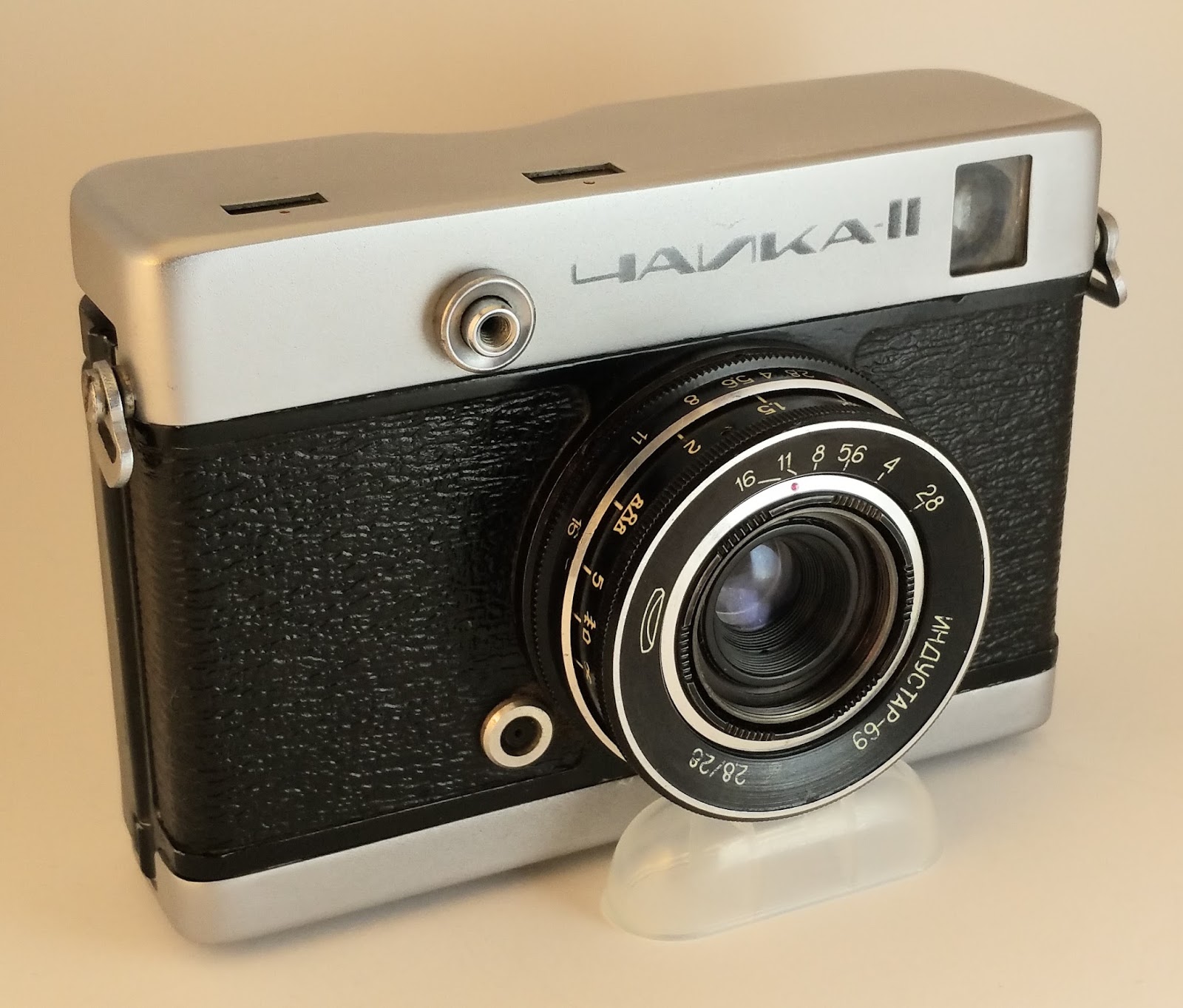
Chaika II is a half-frame 35mm film viewfinder camera made by MMZ, after 1971 made by Belomo and produced between 1967-72 with quantity of 1.250.000 units. Chaika (Чайка) means Seagull.
Chaika was the call sign of the first Russian female cosmonaut, Valentina Vladimirovna Tereshkova. She became extremely famous for her achievements and is still considered a hero in Russia. It's very likely that this line of cameras were at least partly named in honor of her. Her famous flight took place 1963 and the first Chaika camera was sold in 1965.
The difference between Chaika-I and Chaika-II is added a removable screw mount lens which could be used as the lens for an enlarger that was apparently never made available. The threads are the same as those for a Leica lens, but the focusing distance is different, so the lenses are not compatible.
There are 6 types and 9 sub-types of the Chaika-II
Picture size 18x24mm
Lens: Industar-69 (ИНДУСТАР) 28mm f/2.8 filter slip-on serial no.none
MMZ logo on the lens
Aperture: up to f/16; setting: ring and scale on front of the lens
Focus range: 0.8-5m +inf
Focusing: manual front cell focusing; ring, distance scale with symbols and DOF scale on the lens shutter barrel
Shutter: leaf shutter; speeds: 1/30-1/250 +B; setting: by a ring and small window on the top-plate
Shutter release: on front of the top-plate, w/cable release socket
Cocking lever: also winds the film, short stroke, on the back of the top-plate
Frame counter: additive type, auto-reset, window on the top-plate
The Chaika-II (Seagull in Russian) is a great half frame scale focusing camera. It is simple, compact, well made and allows you to shoot close to 80 pictures on a standard 36 frame roll of 35 mm film. It was dame in the 1960's by the BELOMO factory in Belarus.
Features:
18x24 frame size
Shutter speeds: B, 1/30 - 1/250. Leaf shutter built into the body,
Lens: Industar-69, 28 mm/f:2.8, sharp and contrasty. It can be unscrewed from the camera body and used as a wide angle enlarger lens (39 mm screw mount, not Leica compatible)
Release button on the front
Flash sync
Film advance with a crank lever
All metal body
Hinged back door
Rewind knob with a film speed (in ASA!) memo dial on the bottom plate.
This is a scale camera, the focusing is done by the symbols and the distance scale on the lens. The focusing is easy and does not need to be very accurate to obtain good quality pictures. The camera was marketed as a "pocket" model, it is only 41/4"x3"x2".