The Dynax 300si is a 35mm SLR camera manufactured by Minolta and released in 1995. It is also known as the Maxxum 300si in the Americas. It was also sold in American Ritz Camera stores the as the Maxxum RZ300si.
A date version was also available called Dynax 300si QD while the Ritz Camera version is Maxxum RZ330si or 330si RZ as written on the body. A panorama variation called Maxxum 350si was also available. It was also known as Maxxum Panorama Elite. The Japanese version is called α-101si (Alpha 101si).
The user has a choice between fully automatic program mode "P" and five pre-set programs, including portrait, landscape, macro, sports and night-portrait. It has no manual program mode of any kind.
Year of launch: 1995
Manufacturer: Minolta
Type: Autofocus system single lens reflex camera
Lens mount: Minolta AF mount
Film type: 35mm film with speeds of 25 to 5000 ISO, with auto DX (25 to 1000 ISO for flash photography)
Metering: TTL, 8 segment silicon photo cell.
Metering range: 1 to 20 EV (50mm f1.4)
Focusing: CCD TTL phase detection autofocus with AF illuminator.
Programs: landscape, sports, macro, portrait and night portrait
Flash: Guide number 12
Shutter: Focal plane shutter with speeds from 30sec to 1/2000sec, 1 fps
19315669322_841f1a26b4_m_d.jpg
image by John Warwick (Image rights)
Film advance: fully automatic morotorized advance and rewind
Viewfinder: Pentamirror
Battery: 1x 2CR5 6V Lithium battery
Dimensions: 147 × 101 × 68mm
Weight: 380g
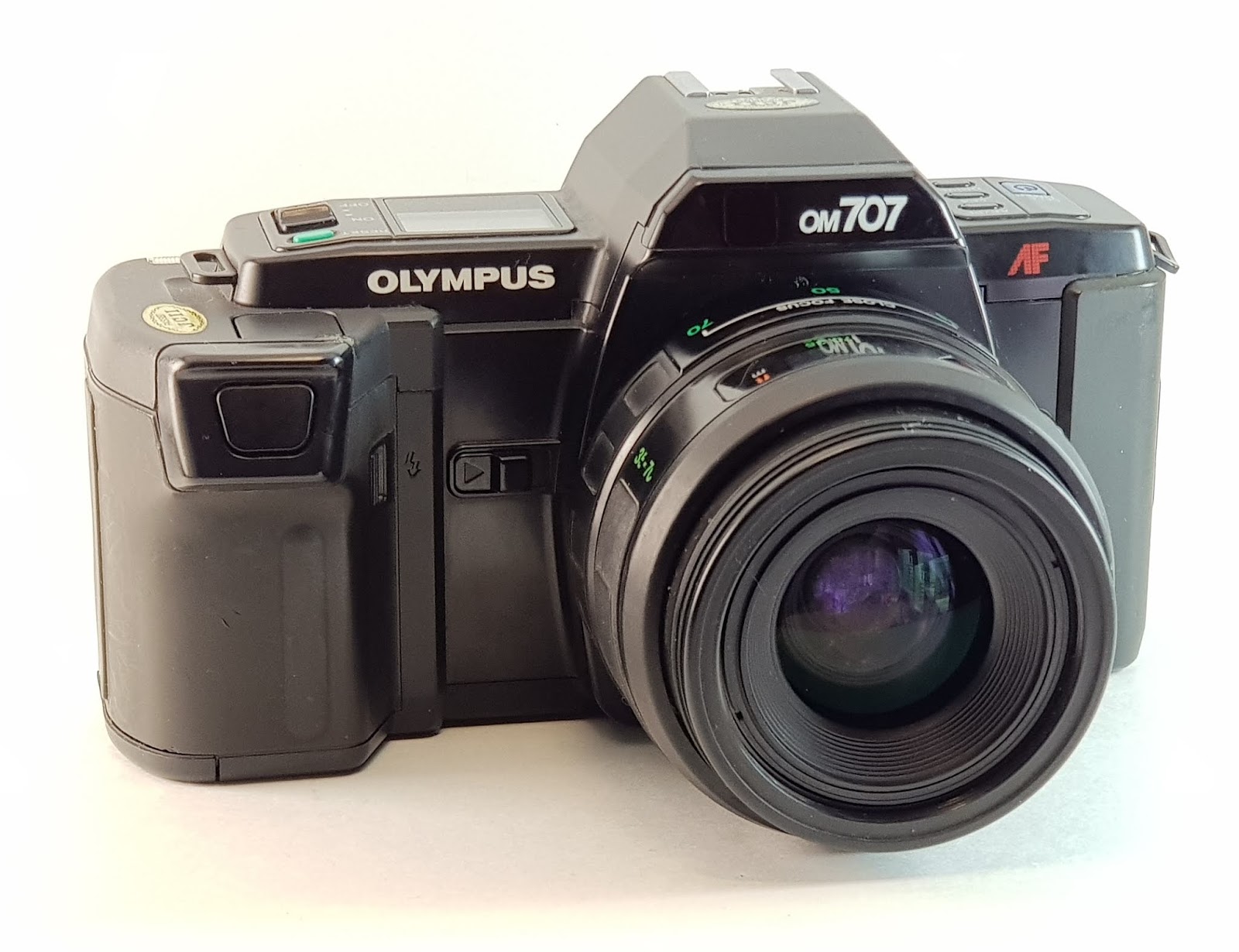
he Olympus OM-707 was released by Olympus as part of its successful OM system in 1986, and was their first attempt to make a fully autofocus SLR body. On some markets, it was called OM-77.
In 1985 the Minolta 7000 had been a usable AF SLR, after various unsuccessful attempts like the Pentax ME-F, the Olympus OM-30, the Canon T-80 and the more serious Nikon F3AF. It led to rival models including the Nikon F-501, the Canon EOS 650, the Olympus OM-707 and the Pentax SFX being released. The OM-707 was the least successful of all. It maintained the OM bayonet mount and could mount all the Olympus OM lenses, but the new OM AF lenses specially designed for the autofocus did not have any manual focusing ring. This was unpopular because the first autofocus systems weren't very accurate or sensitive and there were many cases when manual override was necessary. Olympus' solution to this was to include a 'Power Focus' feature whereby a sliding 'shift knob' on the rear of the camera controls the focus. This is relatively accurate, though does not offer the same precision or speed as a manually-focused lens offers. This feature actually outlived Olympus' OM autofocus to reappear on the OM-101 which was Power Focus only. The OM-707 generally lacked all the features of a top range camera, and was aimed at the middle range market, like the OM-10.
The OM-707 also dropped compatibility with nearly all the accessories that made so much for the success of the OM system. There was one OM system accessory released specifically for this camera however: its partner the F280 Full-Synchro stroboscopic flash, syncing with this up to 1/2000 of a second. This flash/camera combination was reportedly the first in the world to offer such high speed syncing. The F280 also features a high-power AF illuminator lamp to aid low light focussing.
Another 'accessory' released for the OM-707 was the option of two grips with which to hold the camera. The Power Flash Grip 300 is powered by 4x AAA batteries and features a built-in pop-up flash; the alternative Power Grip 100 is again powered by 4x AAA, features no flash, but is far less bulky to operate. Both grips feature the shutter release switch: without a grip attached the camera is unusable and un-powered.
Unfortunately, the robustness of both Power Grip 100 and Power Flash Grip 300 is poor, with many suffering from failures of the plastic casing around the battery covers, rendering many otherwise perfect cameras unusable. Olympus were inundated with warranty claims and repaired many of these grips under warranty, some more than once within 12 months! There was no revised design, so even repaired grips have the same reliability issues. Spare grip casings were available (from Luton Cameras - Olympus UK repair agent) until around 2002, but are no longer available.
Occasionally the battery covers themselves for both Power Grip 100 and Power Flash Grip 300 become available on ebay at around $16 from a camera repair agent in USA, but these are only suitable as replacements for lost battery covers, and will not solve the more common failure issue with both grips which is the casing itself.
Any would - be purchaser on ebay or other auction sites would be well advised to ask about the condition of the battery cover, as many are crudely repaired with tape or screwed shut. Those with secure battery covers are at a premium.
The market failure of the OM-707 led Olympus to go in a different direction. They made one last camera using the autofocus/powerfocus lenses, the OM-101 and then began to develop the IS series bridge cameras. Today Olympus continues this strategy of producing cameras somewhat different from the other makers with the Four-Thirds and 'E' systems.
The Olympus OM707 is a camera Olympus would probably rather forget all about. But the fact that almost everyone else had indeed forgotten about it is probably of little comfort! The OM707 was Olympus's first and last 35mm AF SLR, and I don't think it's going too far to say that the OM707 was a disaster for Olympus: it's failure effectively brought about the end of what had been one of the iconic 35mm SLR systems of the 1970s and 1980s. The OM707 was launched in 1986, and by 1987 Olympus has practically given up on 35mm SLRs, having deleted almost their entire line. The only models that survived any significant time were the expensive, top-of-the-line OM-3Ti and OM-4Ti models.
Olympus went on to launch just 3 35mm SLR cameras post OM707, only one of which was genuinely new and genuinely Olympus: that was 1988s even more forgettable power-focus-but-not-auto-focus OM101. 7 years later in 1995 Olympus surprised everyone by launching an updated version of the all-manual, all-mechanical, OM-3 called the OM-3Ti. But by then it was nothing more than a beautiful and charming anachronism that sold for Leica-like prices only to well-healed collectors. (The OM-3Ti is still a very valuable collector’s item today.) The last OM camera was OM2000 from 1997, but it wasn't a real Olympus at all. It was made by Cosina and apart from the OM lens mount it wasn't compatible with any of the Olympus OM system. The OM system limped on in this state until the early 2000s.
I've always had it in my mind that the reason Olympus failed so spectacularly with the OM707 was because they were late to the AF SLR party. But when I did some research on the OM707 I found that this wasn't the case at all. In fact Olympus were among the first to act after the launch of the first true body-integral AF SLR, the Minolta Dynax 7000. Here's the chronology: Minolta launched the Dynax 7000 in 1985, Nikon launched the F501 and Olympus the OM707 in 1986. And finally Canon launched the EOS 650 and Pentax the SFX in 1987. In other words Olympus beat Canon to the market by some margin, and yet it was Canon that went on to thoroughly dominate both the professional and consumer 35mm AF SLR markets with their EOS system. Not only that, but Olympus as quick to launch a surprisingly comprehensive set of AF lenses for the OM707. Within a couple of months they had a set of 8 lenses with focal lengths from 24mm to 210mm, including a macro lens.
So if being late to the party wasn't the problem, why was the OM707 such a disastrous failure?
I think the first reason was that the OM707 was strictly an auto-only camera. The OM707 was, like all early AF SLRs, an expensive piece of cutting-edge technology. Yet in the minds of most camera buyers a lack of any kind of manual mode indicates a low-end beginner's camera. The OM707 did have what at the time was a highly innovate program-shift facility, so you did have some control over shutter speed and aperture. But although the OM707 provided some control over shutter sped and aperture, the only way to influence the exposure value selected by the camera was an exposure lock… there was no exposure compensation facility and now way to manually set ISO. So there just wasn't enough manual control to attract the kind of person who was willing to spend serious dollar on the latest cutting-edge tech.
But I don't think that was Olympus's biggest mistake with the OM707; the real disaster was the design of the lenses. The OM AF lens mount was Olympus's first attempt to modernise the OM lens mount since it was introduced in 1972. While other manufactures were busy adding electronic communications to their lens mounts even in the manual focus era, Olympus refused to change the OM mount at all. This was what prevented Olympus from ever offering a true multi-mode electronic control camera.
But with the OM AF lenses they took the brave but ultimately fool-hardy decision to remove all controls from the lenses (except for the zoom control in the case of zoom lenses). Yes… that's right… they didn't just remove the aperture ring from their interchangeable lenses like Canon and Minolta did, they removed the focus ring too. In fact, as far as I know, there were the only company to do this. There was a manual focus control, but this involved using a power-focus control on the camera body. Olympus made things even worse by using the same slider control on the camera body to control both the program-shift function and the power-focus function. So you could control aperture/shutter speed, or you could manually focus, but not both at the same time!
Like Nikon and Pentax, Olympus chose to add AF capabilities to their existing OM lens mount rather than then introduce an entirely new AF lens mount (which is what Canon and Minolta did). So you could mount an only OM lens on the OM707 without an adaptor effectively giving you an aperture-priority auto-only camera with manual focus… but this was only an effective option for existing OM system owners… if you’re new to a system you don’t want to have to buy a duplicate set of old legacy lenses just to get proper manual focus!
The decision to make the OM707 an auto-only camera could easily have been fixed with the next camera, but the lack of a focusing control on the lenses would have been much harder to fix. Lenses should be a much longer term investment than cameras. With an SLR you not just buying a camera, your buying into a camera system. People want to preserve their expensive investment in lenses by continuing using them when new cameras are launched. Understandably people were reluctant to buy lenses without focus controls and risk the possibility of rendering them useless if Olympus had decided to abandon the highly unpopular on-body power-focus control on later camera bodies.
Another problem was that all though you could put older OM lenses on your OM707, the lack of a focus control (plus the lack of the normal OM lens release button) meant you couldn't use your OM AF lens on an older OM body in manual focus mode. This was something you could do with both Nikon and Pentax AF lenses.
But failures can sometimes interesting because unlike 10-a-penny successful cameras the tend to be rare because no-one bought them.
And the OM707 did have a number of highly innovated features, many of which were firsts: a program mode with program-shift functionality (Canon launched the T90 with program shift functionality also in 1986, but I'm not sure which was first… let's call it a dead-heat!), lenses without focus controls and an on-body power-focus control (though as already discussed this was innovative but foolish!), plus the first flash system with allowed flash sync at all shutter speeds with a focal-plane shutter (with the F280 flash unit). The design had some interesting little quirks too, like the grip with a built in pop-up flash (a smaller grip without a pop-up flash was available too).
But the list of disadvantages is much longer! There is no exposure compensation, no way to manually set the ISO setting, no depth of field preview (which was available on all previous OM cameras as the depth-of-field preview button was on the lens with older OM lenses), the power manual focusing is horrible and you can't use your new lenses on your old OM camera, And the final nail in the OM707 coffin is the awful handling, as least it is with the power grip 300 with the built in flash that came with my camera. Somehow the shutter button is much to low down the front of the camera and the power-focus/program shift slider control is in the wrong place, at least for left-eyed people like me… you always seem to end up jabbing your right thumb into you right eye when you use it!
In fact now I have an OM707 in my hot little hands I think I've been cured of my fascination… let's just say I'm glad I only paid £11.50 for it!
Shutter: Electronically controlled vertical travel focal-plane shutter. Shutter speed: 2–1/2000 sec
Lens Mount: Olympus OM for AF lenses (accepts OM manual and OM-AF lenses)
Exposure Control: TTL 'OTF' centre-weighted.
Exposure Mode: Program; Program shift (with shift knob); Aperture priority with OM manual lenses.
AE lock; AF lock
Flash Control: Full synchro with F280; TTL 'flashmatic' sync up to 1/100 with PowerGrip 300; TTL direct 'OTF' with T-series flashes.
Viewfinder: 93% of field fixed screen with marked autofocus zone
Auto film loading; auto film advance (1.5 fps); auto film rewind
12 second self-timer
Weight: 555g without lens/grip/batteries
Built-in AF Illuminator lamp
In the 1980s the import company Miranda Foto Video GmbH in Nürnberg, Germany has sold a line of Exakta HS cameras, built by Cosina in Japan. They all have the Pentax K lens mount.
This import company was owned by Heinrich Mandermann, an important WestGerman foto and video trader. He had an agreement with Pentacon Dresden - the company in which Ihagee had disappeared - in 1981/82 with Pentacon to use the name Exakta for five years, paying DM 50.000 per annum. Mandermann bought the whole of Pentacon around 1990 when this company went bankrupt during the unification of Germany.
It's a Cosina-built Pentax-K mount 35mm SLR that was produced around 1989-90. Also known as Cosina CT1EX. Hardly a classic in any definition, but it's a solid, no-frills PK camera.
This camera is an evolution of the CT1 Super. Under a design (a little) more modern, one however finds all specificities of his elder: Powerful mechanical shutter and reassuring (functions without battery at all speeds) simple control of the exposuresby 3 diodes green or reds in the viewfinder, Universalité of the mounting Pentax K which authorizes the use of a very wide range of lenses to satisfy most demanding.
The metal roller-blind shutter with vertical run allows speeds of the second the 1/2000. It is synchronized to the 1/125.
The standard lens delivered with the camera was Cosinon 1: 2 F = 50mm
The Zoom Date 70 is a compact 35mm film camera released from Fuji in 2003. It was also sold as the DL-270 Zoom Super. It uses a Fujinon 35 to 70mm zoom lens.
The Yashica 108 MP also known as Yashica 108 Multi Program, Yashica 108, or name variation incorporating Kyocera, Kyocera Yashica 108, etc. It is a 35mm SLR camera manufactured by Kyocera.
A version marked Revue AC8 was available at German Foto-Quelle dealers, a Yodobashi The 30th Anniversary was made for this well known Japanese camera shop. A Chinese market version was available called Yashica FX-80.
It uses the Contax/Yashica mount or C/Y mount. This model is similar to the 107 MP, but has different program modes. There are five program modes. Program auto, HP: hi-speed program auto, AV: aperture priority, manual exposure and manual flash exposure. The shutter release is electronic, a standard cable release socket is also provided. The film transport also supports single or continuous drive mode, the setting is located on the collar of the rewind knob. After all exposures on the roll are exhausted, the camera will stop, to rewind press the button located on the base and use the film rewind knob.
Focusing is done manually, and aided with a horizontal splitimage spot including a microprism. The viewfinder provide 0.82x magnification, providing a nearly 92% field of view. There are LED confirmations in the finder, flash, circle, down arrow and up arrow. The flash lights up when fully charged and blinks when shutter is slower than 1/30 a sec. The circle lights in program modes, and blinks if settings need to be adjusted. The down and up arrows both light if the exposure is correct in manual mode and blinks in B: Bulb mode. If the arrows are individuality lit; in manual exposure mode, setting need to be adjusted. The down arrow is under exposure. The up arrow is over exposure. Blinking in AV mode, means the camera is unable to compensate to the lighting conditions. A handy backlight compensation button is also provided near the lens mount. It adds 1.5 EV to the exposure.
Manufacturer: Kyocera, Japan
Lens mount: Contax/Yashica or C/Y bayonet mount lenses
Shutter: Vertical metal focal plane
Shutter speed: auto: 16s to 1/2000 manual: 1 to 1/2000 and B
Flash: X sync at 1/90 or slower
Metering: TTL center weight with SPD sensor
Metering range: 2 to 19 EV (100 ISO)
Film speed: Auto DX 25 to 3200 ISO, non-DX 100 ISO
Self timer: electronic 10 sec.
Film advance: automatic
Film rewind: manual with knob
Batteries: 4x AAA battery
Weight: about 500g
Dimensions: 149 x 93 x 52 mm
The Cosina C1s is a 35mm SLR made by Cosina, whose products are more typically seen rebranded under other names.
While a manual-focus, manual-exposure camera may seem like a throwback in the 21st century, some users (and instructors of photography) still appreciate a camera that emphasizes the essentials, not unlike the venerable Pentax K1000. The C1s also uses the K-mount lens standard, and so can mount a wide variety of lenses dating back to 1975. On the more modern side, the vertically-traveling shutter reaches 1/2000 sec., and syncs with electronic flash at 1/125 sec. The shutter is mechanical and does not require batteries to operate; power is only required to illuminate the meter display LEDs in the viewfinder.
Both silver and black finish versions were sold.
The Cosina C1 is the same camera, but lacking a self-timer. The C2 and C3 are similar-looking SLRs but offering electronic-shutter autoexposure. The C1s is a continuation of the features Cosina developed for the CT1 Super and variations have appeared as the Dakota RZ-2000, among other names.
Compact lightweight Pentax K Mount 35mm film camera
Mechanical Shutter works WITHOUT batteries
Split image rangefinder focusing screen
With 50mm lens, .86 lifesize magnification and 93% viewfinder coverage
Copal shutter 1/2000 to 1 second plus B range
LED light meter readout in viewfinder
Self Timer, 10 second delay
Short 135 degree film advance with 30 degree standoff
PC flash socket for studio flash and hot shoe for camera mounted flash units
X sync 1/125th and lower speeds
Film window in back door to check if film loaded
Uses easy to find LR44 batteries
Takes standard mechanical cable shutter release
Meter range EV2 to 19, ISO 100 f/2 at 1 second to f/16 at 1/2000th
ISO range 25 to 3200
Cosina 35-70 f/3.5-4.8 Macro Zoom, 52mm filters, close focus to 14"
Weight 370 grams, 138x88x58mm
The DL-270 zoom is a 35mm compact zoom camera from Fujifilm released in 1994.
It was also released in America as the Discovery 270 Zoom. Date versions were available as the DL-270 Zoom Date, in America as the Discovery 270 Zoom Date and in Japan as Zoom Cardia Super 270 Date. It was also available in Kmart store as the Discovery 265 Zoom Date. A Promaster 270 Zoom Date version was also available. Metallic body colour version were available as DL-270 Zoom Date MR, Discovery 70S Date and Zoom Cardia Super 270 Date MR.
Photos can be captured in the traditional size or a cropped panoramic mode. It uses a Fujinon f/5-9.5 35 to 70mm zoom lens that is protected by a built-in lens cover. It has a focus distance of 0.9m to infinity, but at 70mm is is from .65m to infinity. There a multiple flash modes including auto, red-eye, fill, and off. It uses a drop-in film loading system and able to accept DX coded film from 50 to 1600 ISO. It uses a prewind function for the film transport; therefore the exposure counter displays the number of exposures remaining and decreases as exposure are captured. Power is from a CR123A battery.
The camera sports a “lightning-fast” 35-70mm f5-9.5 power zoom lens (5 components, 5 elements
Fortunately, the viewfinder zooms in together with the lens and contains parallax lines as well as a focusing spot
Autofocus from 0.65m (at 70mm) to infinity with autofocus lock lamp next to the viewfinder
Auto exposure control depending on the film DX code (ISO 50-1600)
Drop-in loading and automatic threading
Motorized winding and rewinding
Auto flash, red-eye reduction, fill flash and flash off button
Self-timer
IR remote control
“Panorama” mode
Last but not least, date imprinting!
The Dynax 500si is a 35mm SLR camera manufactured by Minolta. It is also known as the Maxxum 400si and Maxxum RZ400si. A Date version was sold in American Ritz Camera stores the as the Maxxum RZ430si or 430si RZ as written on the body. A panorama variation called Maxxum 450si was also available, which is known as the α-303si (Alpha 303si) in Japan.
A Dynax 500si was also used as a test bed for APS film development. It had additional APS frame markings in the finder and modified film opening on the camera back, but used APS sized film loaded into 135 fiim canisters.
Type: Autofocus system single lens reflex camera body
Manufacturer: Minolta
Year of launch: 1994
Film type: 35mm film with speeds ASA 25 to ASA 5000, DX film speed acknowledgement
Lens mount: Minolta AF mount
Metering: 2 Si photo diodes, one for flash TTL control, EV 1 to 20
Focusing: 1-CCD TTL phase detection autofocus
Programs: landscape, sports, macro, portrait and night portrait
Modes: program, fully automatic, aperture priority, shutter priority, manual settings
Flash: for wide-angle (28mm), guide number 12, flash sync shutter speed 1/90 sec
Shutter: focal plane shutter with speeds from 30sec to 1/2000sec plus bulb mode, 1 image/sec
Film advance: fully automatic morotorized advance and rewind
Display: LCD
Viewfinder: pentaprism, magnification 0.75, 90% of image frame
Battery: 2CR5 6V Lithium battery
Dimensions: 147×92×66mm
Weight: 395g