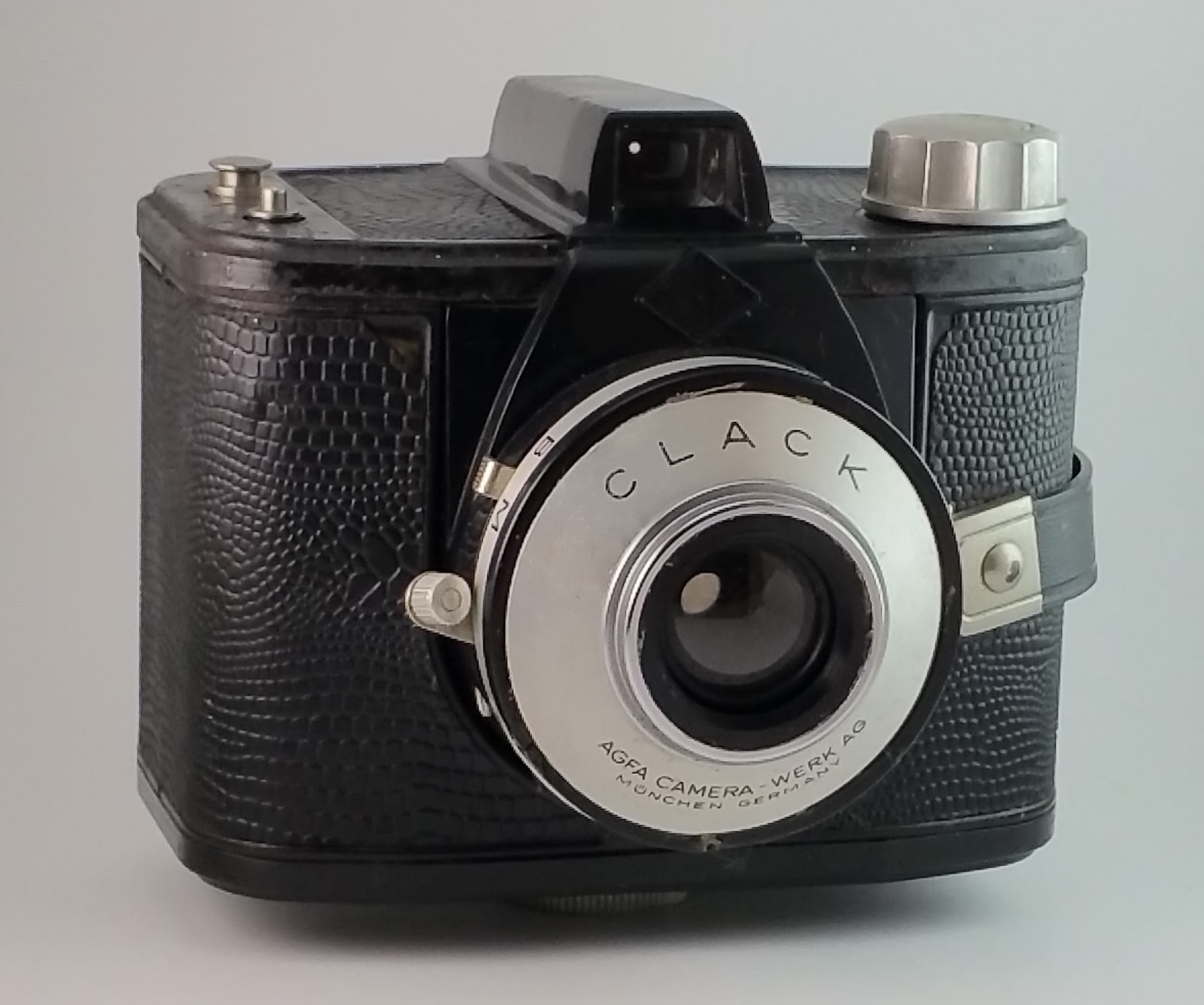
Click-II is a medium format film viewfinder camera manufactured by Agfa Kamerawerk AG, Munich, Germany and produced between 1959-70.
The Click was yet another cheap Agfa camera designed for the Lomography. With its one speed shutter and few option it was never intended to be anything else than this. Unlike it's 6x9 brother the Clack it was completely constructed out of plastic making it quite vulnerable for damage, if you drop a Click it will most likely break. The main differences between the Clack and the Click is the lens, the Clack has a lens of f11 - f16 while the Click has a f8.8 -f11 lens. Other differences are the fact that the Click II is 6x6 camera (opposed to the 6x9 of the Clack) and thus is a little more economic. The Click II also lacks a socket for a cable release and it's a mystery why Agfa decided to drop this feature. The results of the Click II are not bad for such a cheap camera.
The other camera in the Click line is Agfa Click-I.
More than three years ago an Agfa Click II became my constant companion. This circumstance was neither achieved by a high-resolution image sensor nor by any other special features, but is owed to the absence of modern settings. Apart from all the things the Click is lacking, it holds some attributes that make photography such a pleasure. The 50 year old leather case, that closes with a press button on its back and still is in near mint condition, as well as the sturdy plastic body are just the beginning.
Technical details
The Agfa Click II was produced in Germany from the end of the 1950s until 1970 – how many cameras can claim that nowadays? It has approximately 75 mm focal length, which is almost a normal lens for 6×6 cm medium format. The settings of the fixed-focus lens that focuses on 4 m to infinity, are limited to one lever, which can be set to “sun” (ca. f 16) or “clouds” (f 8.8). Apart from changing the aperture, the same selector can be used to swivel in a built-in close-up portrait lens (f 8.8), that focuses on 2.5 to 4 m. The exposure time always amounts to 1/30 sec, which is why sometimes photographs become blurred by camera shake – but this simply belongs to the Click’s characteristics. Once there was the clip-on flash Clibo enabling the Click to take pictures regardless of sunshine, but it was only produced in a much smaller number of pieces. Furthermore, fitting batteries and flash bulbs are extremely rare today.
When I bought my pre-owned Click II, I found an old film inside that had not been manufactured since 1974 – which also explains the camera’s sound condition. Since then I have almost exclusively equipped the camera with (in part expired) slide film. By choosing the film material the last “setting option” is gathered.
En route with the Click
In all fairness, the technical details concerning the Click are of marginal importance. Much more essential are subjects that stand to benefit from a restrained unsharpness and vignetting as well as a colour shift which results from expired film emulsion. Therefore it is definitely worth taking the Click outside. Weighing only 460 g (including leather case and roll film) it is far from being a burden. For my liking the Click is primarily a fair weather camera, although it can be used in all weathers, independent of power supply and anywhere around the world. All that is necessary is a 120 roll film, which is manually wound forward by means of the winding knob after every single exposure. Due to the few settings (one exposure time and two apertures) photographing with an Agfa Click is so easy – far from the compulsion to take perfect pictures. When getting the film developed you will never know in advance what you will receive exactly. (However you can be sure to get a well exposed film as the Click is much more reliable than a Holga without doubt.)
The Agfa Click II provides all images with its own characteristic visual impression, even those that would look rather unexceptional and boring when captured with perfect sharpness, perfect colour reproduction and perfect exposure. That is what makes the Click so special and in my opinion more than perfect. When it is treated well, it will probably render a service for the next 50 years or more – as long as roll film and film laboratories exist.
Film: 120 roll, picture size 6x6cm
Focusing: fixed focus, 4m to inf.
Viewfinder: simple Galilei
One shutter speed, about 1/30
Lens: Achromat 72.5mm f/8.8; downs to f/11
Aperture settings: cloudy and sunny setting ikons on the lens-shutter barrel; switchable lens proves 2.5-4m close-up taking
Tripod mounting screw on base plate
Connection pins for the Agfa Clibo flash unit
The bend back cover plays a role as a film pressure plate and provides for a steady and good sharpness
Body: plastic
The Isolette is a compact horizontal-folding camera for twelve 6×6 cm (2¼-inch square) pictures (or sixteen 4.5×6 cm (2¼×1⅝ inch) pictures, with the first model of the camera) on 120 film. It was made by Agfa Kamerawerk AG, Munich, Germany, from 1937, and the series of cameras continued until about 1960.
Some of the series were sold (and some made) in North America by Ansco as Speedex models.
The cameras are as follows: The original Isolette (1937-42)
Isolette 4.5 (1945-50)
Isolette V (1950-52)
Isolette I (1951-58)
Isolette II (1950-60)
Isolette III (1952-58)
Isolette L (1957-60)
There was also the Super Isolette (1954-60), a coupled-rangefinder camera.
This first model (1937-42) is a dual format camera. It has hinged masks in the film chamber (they pivot around the spindle of the film rollers on each side of the film gate), to change it from the 6×6 cm format to 4.5×6 cm. There is also a mask for the viewfinder, put in place with a selector lever by the eyepiece.
It first came on the market as the Isorette (embossed in the leatherette of the front door/lens bed as JSORETTE), but the name was changed to Isolette (again, marked on the camera as JSOLETTE) within a year, with no significant change to the camera itself.
One of the distinctive features of the camera is the top housing, made of a plastic called 'Trolitan'; the post-War camera has a cast aluminium top housing. This camera also has loops to attach a strap, the only version of the Isolette to have these.
Different lens and shutter combinations were available, allowing a wide range of levels of specification. All have front-element focusing. The shutter release is on the body. Film advance is by a wide, flat knob, using a red window; there are two red windows in the back, one for each film format, and a swivelling cover for the upper (4.5×6 cm) one. There is a swing-out spool holder on the supply side of the film chamber. This model was called the "Soldatenkamera" (soldier's camera) in Germany during the War.
Year of release: 1937
Film Format: 12 exp. 6x6 or 16 exp. 4.5x6 on 120 type rollfilm.
Shutter: Vario, Pronto, Prontor II, Compur or Compur-Rapid.
Lens: 8.5 cm f/6.3 Igestar, f/4.5 Agnar, f/4.5 Apotar or f/4.5 Solinar.
Viewfinder: reverse-Galilean viewfinder
The earliest cameras have Vario shutters which are not labelled as such.
Câmara gentilmente cedida por Isabel Alber Características
Agfa Synchro Box 600, also known as Agfa Synchro Box, is a medium format box camera manufactured by Agfa Camerawerk AG, München, Germany between 1951-57. It is a version of Agfa Box 50. The Synchro term in the name is for flash sync shutter.
The optics are rather simple, so image quality is a bit better than a toy camera, but not significantly so. Photographs can have the dreamy soft focus like Holga pictures, but unlike toy cameras, image quality is fairly sharp throughout the photograph with little or no vignetting around the edges. Also, the large negative size is a definite plus, just print contact sheets from Synchro-Box negatives.
It’s so cute I can hardly stand it! I don’t know why I keep thinking they’ll be bigger, like a lunch box or something, but I can’t get over how tiny these little B2 box cameras are. (On an 800×600 screen the above picture is actual size!) This one is all-steel, but it’s still very lightweight for its size – box cameras are so simple they’re mostly hollow. Only one shutter speed, ‘instant’, I’ll guess about 1/30. Instant-return self-cocking shutter like on the Shur-Shot. In fact the whole thing is very like the Shur-Shot. A tab pulls out above the shutter release with your choice of two apertures and a yellow filter, and another button above the tab allows you to change from ‘instant’ to ‘time’ (like ‘B’). Bright magnifying viewfinders, not ground glass like on the Shur-Shot. Only one aspect ratio though, 6×9.
Agfa boxen have model numbers, and this is Agfa box 600, aka the ‘Synchro Box’. Synchro is for flash sync, as it accepts and syncs with the Clibo-Blitz flash, the same as on the Agfa Clack. Ich don’t spreche too much Deutch but I’m pretty sure that Clibo-Blitz means ‘Clip-on Flash’. The Agfa box 600 was apparently also made in France and India; this one says ‘made in Germany’ on the front so I know it was made in Munich at Agfa-Werk proper.
No sticker inside to indicate film type for a change. For consistency’s sake I’ll guess it was meant for DIN 17 / ASA 50 but will gladly accept ASA 100/120.
Repairs
None – just needed a basic cleaning, particularly the glass, which is thankfully clear. I did disassemble the thing and clean the viewfinders, both sides, the protective front glass, both sides, and the single-element (?) lens. Part of the tough cloth covering is peeling up, I’ll glue that, and there are some scratches on the paint which are strictly cosmetic. The rubberlike handle (as opposed to leather on the Cadet and Shur-Shot) is in perfect shape.
ips & Tricks
Tripod mounts! Cable release socket! Flash sync! Wow! AND – a built-in yellow filter. Yellow filters are useful in black and white photography for increasing sky contrast and smoothing out skin tones, in fact it may be the most common colored filter used with black and white film. Here, one is built in so you don’t have to worry about crazy stuff like taping a filter to the front of the camera. (Though that works too.) The tripod mounts are exciting, now I have a matched set with my Agfa tripod. The cable release socket is at the corner below the pull-out tabs. And as for the flash, I am told that the Clibo-Blitz takes an Osram XM1 bulb, and that other Philips bulbs like PF1 or PF1B will fit as well. Its battery is a 22.5V.
Loading film: don’t forget that you need to pull out the film wind knob before you can get the ‘cone’ out. You’ll know which way the cone goes back in by the location of the extra hole for the winder. See Marcy’s ‘Box Camera 101‘.
According to the manual (see link below) the small aperture is equal to f16, I would presume that the large aperture is equal to f8. And if f16 coupled with DIN 17 (ASA 50) is right for bright sun, then the shutter speed must be about 1/50 or so. Ah, algebra… It also says to use the yellow filter only in bright sun, and that the DOF doesn’t change with the small aperture, you just get sharper pictures 😉 Large aperture is for cloudy/overcast; use T setting (long line instead of dot) for indoors. Or just throw some 400 film in there and forget what I just said.
lm 120 roll, format 6x9cm, takes 8 frames
Lens: 105mm f/11 single-element Meniscus lens, fixed focus; Aperture: f/11 and f/16; Focus range: 3m-inf; Setting: a pull-out tab above the shutter release, without pulling out the tab setting on the large aperture, when pulling out, the first stop (a dot) is for small aperture and the second (filter) stop is for larger aperture w/ yellow filter,
Shutter: instant-return self-cocking simple spring rotary shutter, simple spring, w/sliding aperture disc; Speeds: 1/50 +B; Setting: by a small sliding lever above the shutter release: the dot is for speed and the long line is for B setting
Cocking and Shutter release lever: same, pressing once to downwards the lever cock and release the shutter
Cable release socket: same with flash PC socket, at the corner below the shutter release
Viewfinder: two Bright magnifying viewfinders on top and right sides of the camera, w/ polished steel reflectors
Flash PC socket: special for dedicated Agfa Clibo-Blitz, same with cable release socket, at the corner below the shutter release
Back cover: hinged, w/ red window, opens by pressing the carrying strap knob on top of the camera
Film loading: via a removable cone magazine[1]
Others: Sticker on the magazine: Agfa Isopan Film; Tripod sockets: two, 1/4 inch; Buttons for hand grip
Body: metal; Weight: 412g
Loading: open the back cover, then pull out the winding handle when rotating, and then pull out the inner part of the camera,the lens on it, then insert the film roll to the lower plate, and place it to the upper take up spool, then insert the film magazine into the camera and pull in the winding lever, then close the back cover, wind the film until the number 1 visible in the red window.
Agfa was one the first manufacturers of cameras to follow Kodak after the launching of the 110 film.
Agfa is one of some to propose cameras and 110 film.
The 110 film declination of the 126 film instamatic despite a lot of hope and some beautiful machines (Pentax Auto110, Rollei A 100) has completely disappeared now complete. The Disc film and after APS film replaced it. APS film is itself now on the decline.
The family of Agfamatic pocket is characterized by a very good manufacture, they comprise all a tripod socket, which serves to screw the strap, an orange resilient pad - the 'sensor' and destined for minimize the moved, one of defects of 110 camera
The film is advanced Minox-style (Minox B and C) by pushing the end of the camera in and out - the moving body section also extends around the front to protect the lens & viewfinder.
The body is mainly black plastic, with a few metal components both internally and externally - the body end & cover section is in brushed aluminum, with a couple of extra aluminum trims on the main body.
The shutter and speed switch are on the top panel, and a slide-lock to hold the body closed when not in use.
Le 4000 est très proche du 2000 et du 3000. Son objectif est plus lumineux (Apotar 6,3/26mm). Les pictogrammes météo sont remplacés par des dessins représentant un paysage, deux personnages ou une personne. Comme sur le 3000, la petite fenêtre présentant ces petits dessins affiche aussi une échelle de distance (en caractères bleus), lisible en pieds ou mètres et qui n'a d'intérêt que lorsque un flash est utilisé.
Par défaut, cet appareil est destiné à utiliser des flashcubes.
MODEL 2000:
(1973) Lens: fixed-focus "Color Agnar" of unknown focal length, possibly 26mm. The instructions claim a focus range from about 1.2 meters / 4 feet to infinity.
Shutter: Mechanical shutter with switchable speeds of 1/100 sec. and 1/50 sec. The shutter is mounted externally, in front of the lens. The speeds are marked by 'idiot' symbols - Sun for 1/00 sec., Cloud for 1/50.
Aperture: fixed possibly f/5.6.
Identifiers: "AGFAMATIC 2000", "pocket" and the Agfa logo engraved in black on the front panel, "AGFAMATIC 2000" and "sensor" in white print on the top panel. The cardboard packaging refers to this model as "Typ 2300/700/777"
Dimensions:
Closed: 113 (L) x 53 (W) x 27 (H) mm / 4.4 (L) x 2.1 (W) x 1.1 (H) inches
Open: 133 (L) x 53 (W) x 27 (H) mm / 5.2 (L) x 2.1 (W) x 1.1 (H) inches
Weight: 200g
Price: n/k
Features: Magicube socket - inserting a Magicube (Flash-cube with mechanical activating)switches the shutter speed to 1/50 sec. Inserting an used Magicube triggers a signal in viewfinder.
Accessories:
MODEL 4000
(1974) Evolved version of the model 2000 with a more luminous objective "Apotar" of 26mm/6,3 and a variable exposition controlled by an electronic shutter.
Variable speeds of 1/250 sec. to 30 sec. Focus applied by pictograms: Mountain, Group (Two persons) a person.
These pictograms are completed by a scale of distance (in blue characters), in feet or meters that is coupled to diaphragms for the utilization of the Magicube. 4m, 2m and 1,2 m. A led in the finder indicates the correct exposure and if you have to use flash. The fact to insert a Magicube fixes the speed on 1/50.
Lens: " Color Apotar "
Identifiers: "AGFAMATIC 4000", "pocket" and the Agfa logo engraved in black on the front panel, "AGFAMATIC 4000" and "sensor" in white print on the top panel.
Window of the visible electronic cell on the frontal panel,
Trap for two button piles near the slide-lock.
Other characteristics are the same as the model Agfamatic pocket 2000
Silette is a name used by the German maker Agfa from 1953 to 1974 to designate successive generations of 35mm fixed-lens viewfinder cameras. The corresponding rangefinder models were called Super Silette. There was also an interchangeable lens rangefinder model called the Ambi Silette, which is discussed elsewhere. The first models were sold in the USA under the name Ansco Memar and Super Memar, and some of later ones were sold under the name Agfa Solina.
Agfa Silette (original) is the first of the long lasting Silette series 35mm film viewfinder cameras made by Agfa and introduced in 1953.
Its features are a simple viewfinder, a leaf shutter, a lever wind advance and an accessory shoe (Agfa KM flash compatible). The camera is well made by with simple features. Its shutters are Pronto (1/25-1/200), Prontor (1/300) Compur-Rapid or Synchro-Compur (1/500). The lenses are three element Agfa Color Apotar 3.5/45mm or 2.8/45mm, or a four element Agfa Color Solinar 2.8/50mm. In the USA, it was known as the Ansco Memar.
Esta fotografia é do exemplar que possuo. Características
A higher-specification model in Agfa's "Sensor" lineup of cameras (with the trademark red shutter release button), accepting 126 film. It was billed as having "CdS Computer Automatic" exposure control.
Esta fotografia é do exemplar que possuo. Características
Vintage 126 Agfa film cassette viewfinder camera made by Agfa in Munich (Germany) in 1972.
The Agfamatic 50 is part of the extended Agfamatic family and floated on the same popularity wave as the famous Kodak Instamatic. It has a very simple, plastic body and is fitted with a fixed aperture lens (f11) and exposure time of 1/40 or 1/80 when using flash. The focal range is an almost-standard 40mm.
It came with a plastic carying case which features a handy hand strap on the top (11 x 7 x 4,5 cm – 4,3 x 2,6 x 1,8 inch).
Esta fotografia é do exemplar que possuo. Características
Agfa Silette LK Sensor is a 35mm film viewfinder camera made by Agfa, Germany and introduced in 1969.
It belongs to the long lasting Silette series. Red "Sensor" shutter release button is the distinctive mark of Agfa cameras in the seventies. It was probably the shortest and softest shutter release pressure in its time. Camera shake is reduced so effectively. The exposure meter is displayed at the top of the housing and viewfinder. The Agfa Silette LK, incidentally no rewind.
In 1973 Silette LK Sensor's top housing was made by plastic.
Especificações
Lens: Agfa Color - Agnar 45mm f/2.8
Aperture: f/2.8 -f /22, stepless allowing foreasy adjustment with the TTL meter; setting: ring and scale on the back of the lens
Focus range: 1-5m +inf.
Focusing: front ring manual focus, w/ DOF scale
Shutter: Parator speeds: 30, 60, 125, 300 +B, extremely quiet; setting : ring and scale on the lens
Shutter release: Red "Sensor" shutter release button, very smooth and sensitive so no camera shake
Cable release socket: on the back of the top plate
Exposure meter: TTL (coupled to the lens) Selenium Optima 200 Sensor
Exposure setting:
Via the small needle window on the top plate,
Via the indicator in the viewfinder, set the speed and turn the aperture ring
Film speed range: ASA 25-400 (DIN 15-27), setting knob and scales on the lens
Viewfinder: bright frame finder,
Cocking lever: also winds the film, short stroke, on the left of the bottom plate
Frame counter: advance type, manual reset by a button behind the counter window, on the bottom plate
Re-wind release and re-winding: the black lever marked R and arrow on the right lower side of the lens releases and engages the reversing gear thus the cocking and winding lever is the re-wind lever now
Flash PC socket: none, you can use a flash sync. cord with an Agfa flash adapter
Hot-shoe: flash sync. bulbs 1/30, electronic all speeds
Self-timer: none
Back cover: hinged, opens by a latch on the right side of the camera
Film loading: special easy quick loading system
Body: metal
Tripod socket: 1/4"
Esta fotografia é do exemplar que possuo. Características
The Optima Electronic Sensor is a 35mm film viewfinder camera made by Agfa and introduced in 1982. The camera is the last of the range of long lasting Agfa Optima Sensor series.
The Optima Sensor is technically identical with the earlier Optima 535 Sensor. It has a Solitar 40mm f/2.8 in Paratronic shutter with speeds 1/30-1/1000, a simplified focusing by three symbols, and a red signal in the viewfinder in the event of under-exposure.
Electronic sensor series replaced Optima 200 and 500 Sensor cameras. Their features are black body with large bright-frame viewfinder and automatic exposure control with electronic shutter.
Fonte: Camerapedia Brand: Agfa Name: Optima sensor eletronic Format: 35mm Focus: manual Flash Types: no flash (but hotshoe) Exposure: 1/30 – 15 s ISO Speeds: 25-500 Cable Release: yes Tripod Screw Mount: yes The Agfa Optima sensor electronic is a 35mm compact view-finder camera with manual focus. On the top of the lens you can adjust the focus by three symbols (mountains, two people and one people) and on the rear side in Meters and Feet. But it’s not the big problem if you don’t get the right distance it has a wide depth of field. On the front of the camera you can set up the film speed and there is the built in light meter. It got a fast lens and if there is a flash inserted you can manually choose the aperture. I love the red release button on the lever which is also used for rewinding. The body is made out of metal with a plastic coating. And if you open the back unintended, you don’t destroy the whole film cause it is covered in a sealed chamber. (I’m very happy of this feature.) Fonte: Lomography Modelo Só existe um modelo desta câmara Baterias Funciona com três baterias PX625
The Optima 500 Sensor, made by Agfa and introduced in 1969, as part of the Optima Sensor range, is a fairly eccentric 35mm film viewfinder camera with automatic exposure. Like all Agfa Sensor cameras, it has the large round orange shutter release on the top plate. There is also a cable release socket on the back.
The advance lever is on the bottom plate, to the users left. This doubles as the rewind lever. To rewind, the rewind release, mounted beside the lens, is moved in towards the lens and upward - where it latches. The advance lever is now reverse-geared to be a rewinder. Opening the back, using the catch on the right-hand end, releases the film-spool drive spindle- which springs out of the bottom plate, and resets the rewind release. The exposure meter is a CdS meter.
The lens has three focus zones visible from the top, and a distance scale underneath. Semi-circular film speed scale scale in top plate with pointers at opposite ends for DIN and ASA. Manually-reset frame counter in bottom plate. Flash can be connected via a hot shoe, which has a pin to detect the flash gun; a guide-number scale is fitted in the right-hand end.
Lens: Agfa Color-Apotar 42mm f2.8
Shutter: Paratic speeds 1/30-1/500 +B
Power: PX625 battery, placed where the advance lever might be expected. Look for the rectangle on the top right of the camera's back, this is the battery tray of the chamber.
The Optima Sensor 500, made by Agfa in Germany - c.1972/3 - as part of the Optima Sensor range, is a fairly eccentric 35mm viewfinder camera with automatic exposure. Like all Agfa "Sensor "cameras, it has the large round orange shutter release in the top plate. There is also a cable release socket on the back.
The advance lever is on the bottom plate, to the users left. This doubles as the rewind lever. To rewind, the rewind release, mounted beside the lens, is moved in towards the lens and upward - where it latches. The advance lever is now reverse-geared to be a rewinder. Opening the back, using the catch on the right-hand end, releases the film-spool drive spindle- which springs out of the bottom plate, and resets the rewind release.
The lens has three focus zones visible from the top, and a distance scale underneath.
Semi-circular film speed scale scale in top plate with pointers at opposite ends for DIN and ASA.
Manually-reset frame counter in bottom plate.
Flash can be connected via a hot shoe, which has a pin to detect the flash gun; a guide-number scale is fitted in the right-hand end.
Lens: Agfa Color Apotar 42mm f2.8
Power: PX625 battery, placed where the advance lever might be expected.
A minha é do modelo com topo e base prateados. Há também um modelo integralmente negro. Possuo 2 exemplares, um deles (#112) cedido amavelmente por Isabel Alber.
The Agfa Clack is a box camera produced by Agfa from 1954 to 1965. It was sold in North America as the Agfa Weekender. It is a simple camera which was aimed at the mass market. About 1.65 million were produced, more than all other Agfa box camera models combined. It uses 120 film, creating large 6x9 negatives that were usually contact printed (transferred directly from the negative onto photographic paper without enlarging). It has only one shutter speed, and, depending on model, either a single f/11 f-stop or a choice of two.
Fonte: Wikipedia
To enable this camera to take quality pictures with such a simple lens, it is always stopped down to f/11 or below. The large negative size allows usable contact prints. The negatives don't need to be enlarged by so great a factor. The best feature is the curved film plane. There's no pressure plate in the back of the camera; the film isn't supposed to be flattened. The camera body is oval shaped when viewed from above, and the film is led around the curved back of the camera to create maximum sharpness: an intelligent solution to create a low-cost camera of decent quality.
More data:
Aperture f/11 and f/12.5
Shutter about 1/30 plus B
Built-in yellow filter
Zone focusing with two steps:
1-3m (3-10 feet) with a built-in close-up lens.
3m (10 feet)-infinity with just an aperture ring between the lens and the film
Silette is a name used by the German maker Agfa from 1953 to 1974 to designate successive generations of 35mm fixed-lens viewfinder cameras. The corresponding rangefinder models were called Super Silette. There was also an interchangeable lens rangefinder model called the Ambi Silette, which is discussed elsewhere. The first models were sold in the USA under the nameAnsco Memar and Super Memar, and some of later ones were sold under the name Agfa Solina.
Agfa Silette (original) is the first of the long lasting Silette series 35mm filmviewfinder cameras made by Agfa and introduced in 1953.
Its features are a simple viewfinder, a leaf shutter, a lever wind advance and an accessory shoe (Agfa KM flash compatible). The camera is well made by with simple features. Its shutters are Pronto (1/25-1/200), Prontor (1/300) Compur-Rapid or Synchro-Compur (1/500). The lenses are three element Agfa Color Apotar 3.5/45mm or 2.8/45mm, or a four element Agfa Color Solinar 2.8/50mm. In the USA, it was known as the Ansco Memar.
A simple basic example of the older Silette versions.
Shutter, Vario, 1/25, 1/50, 1/200 and B . Afga Agnar 1:3,5, 45mm lens. Produced in the middle of fifties, all metal chrome finish and a black leatherette covering.
AGFA SILETTE 24x36
More than a million amateur photographers all over the world use the Agfa Silette. Small, quick and handy and it masters every situation. Agfa Agnar f. 3,5/45 mm. lens. Vario shutter, B, 1/25, 1/50, 1/200sec and large viewfinder.