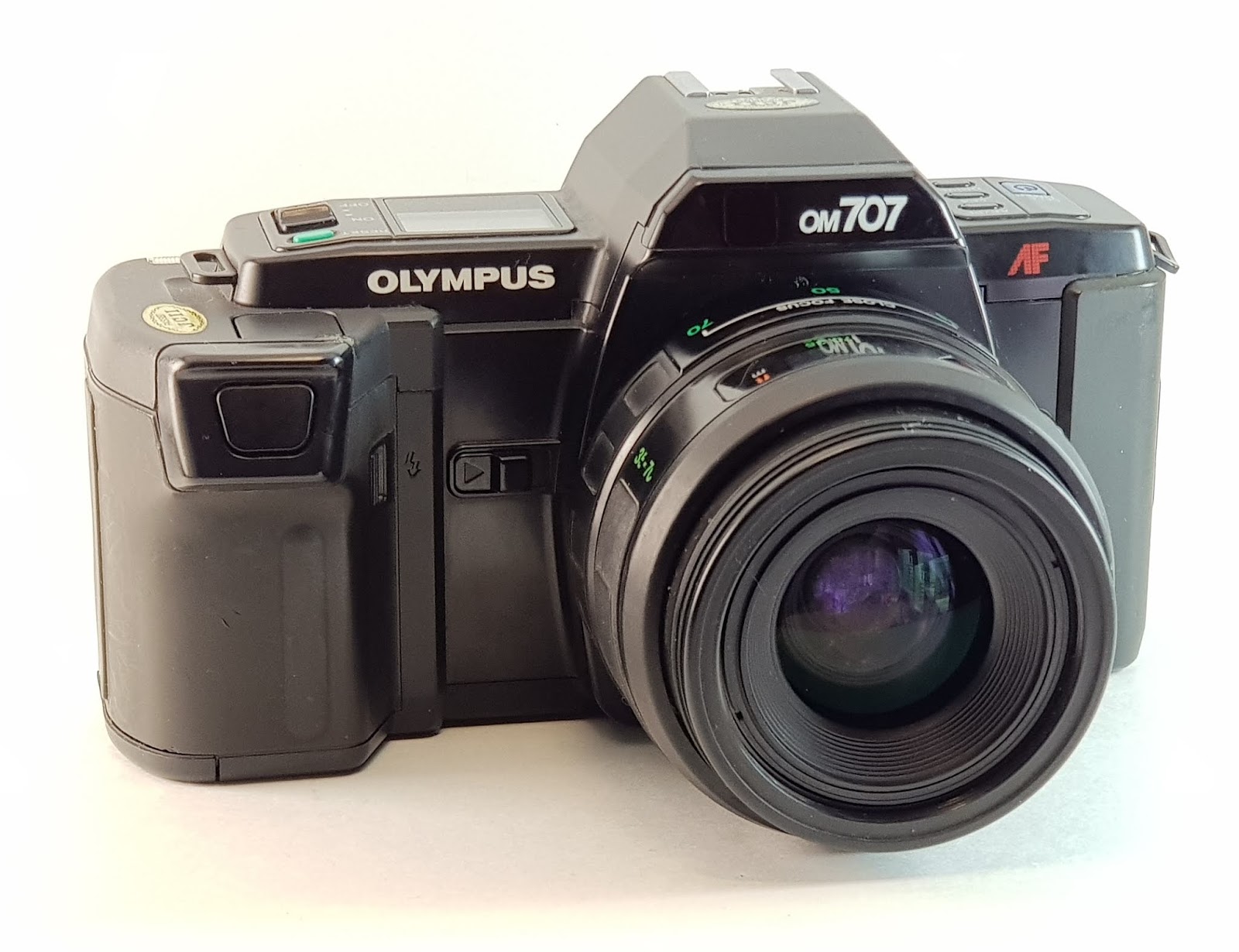
The Olympus OM system was released by Olympus in 1972. The Olympus OM bodies were divided in a high range and a middle range. The top range were the one digit models with a hyphen: OM-1/2/3/4. The two digit models were the middle range. All these bodies could take Olympus OM lenses (which means all potentially have DOF preview functionality, as this was standard on most OM Lenses).
Following the introduction of autofocus into the market, Olympus released two motor-driven bodies: the OM707 and the OM101. Later yet, a re-branded Cosina model was released, known as the OM2000.
The OM10 was the first consumer OM series body. Launched in 1979 it accepted the full line of OM lenses and most of the OM accessories for a lower price. The lower price was reflected in the construction of this camera and the features available, however, it was still a very competent performer and it reflected the elegant lines established by the compact OM-1 and 2 designs. Early production runs of the OM10 have known malfunction issues with electronics, metering, and shutter magnets. Olympus later changed the shutter to a 'Type II' design to correct the latter problem.
In its standard configuration the OM10 offered aperture priority automatic exposure, simple and accurate enough for a consumer camera in most lighting situations. It also offered exposure compensation for more complicated lighting situations and for more advanced users. Selection dial upon the top allowed for selection of Aperture Priority, B and Manual adapter, The small plug-in manual adaptor was available as an accessory to enable manual control of shutter speed, if no Manual Adapter was plugged in and the camera switch set to Manual Adapter then the camera shutter speed was set to fixed 1/60 for flash work.
While not well known to consumers, the focusing screen for the OM10 is indeed interchangeable, though not as easily as the OM-1. It shares the same focusing screen as the OM-1, but the extra protruding tab needs to be cut off as the OM10 doesn't have a placeholder for it.
The OM10 can accept all the lenses of the OM system.
The finder screen is fixed, as well as the back. It can accept the winder but not the motor drive. It existed in chrome and in black finish.
Film Format : 24mm x 36mm
Type: :TTL auto-exposure 35mm SLR camera
Lens mount : OLYMPUS OM Mount. About 50 different Zuiko interchangeable lenses.
Shutter : Electronically controlled cloth focal plane shutter. Manual exposure: B, 1 - 1/1,000 sec. with adapter.
Synchronization : X type contact, hot shoe.
Automatic exposure control : Aperture preferred automatic exposure control electronic shutter type. TTL Direct Light Measuring System, center-weighted average light measurement. Measuring range: ASA 100 from F1.2, about 60 seconds to F16, 1/1,000 second.
Programmed Automatic Exposure : TTL direct, measuring range : approximate. -5 EV ~ 18 EV , 50mm F 1.4
Manual exposure : With a Manual Adapter
Self timer : 15sec. delay
Metering system : Olympus direct metering in body. Full aperture center weighted metering.
Measuring range : EV1.5 - EV17 (ASA 100 with F 1.2 standard lens).
Film speed Setting : ASA 12 - 3200
Power source : Two 1.5V silver oxide batteries Eveready S-76 or equivalents or alkaline manganese batteries LR 44
Viewfinder : Pentaprism type finder.
Finder view-field : 93% of actual picture field.
Reflex mirror : Quick return type (without lockup).
Manual film advance : Lever type with 130° angle for one long or several short strokes, pre-advance angle 30°
Exposure counter : Progressive type with automatic reset.
Film rewind : Rewind crank
Weight : 430g , body alone
Dimensions : 136 x 84 x 50mm, body
he Olympus OM-707 was released by Olympus as part of its successful OM system in 1986, and was their first attempt to make a fully autofocus SLR body. On some markets, it was called OM-77.
In 1985 the Minolta 7000 had been a usable AF SLR, after various unsuccessful attempts like the Pentax ME-F, the Olympus OM-30, the Canon T-80 and the more serious Nikon F3AF. It led to rival models including the Nikon F-501, the Canon EOS 650, the Olympus OM-707 and the Pentax SFX being released. The OM-707 was the least successful of all. It maintained the OM bayonet mount and could mount all the Olympus OM lenses, but the new OM AF lenses specially designed for the autofocus did not have any manual focusing ring. This was unpopular because the first autofocus systems weren't very accurate or sensitive and there were many cases when manual override was necessary. Olympus' solution to this was to include a 'Power Focus' feature whereby a sliding 'shift knob' on the rear of the camera controls the focus. This is relatively accurate, though does not offer the same precision or speed as a manually-focused lens offers. This feature actually outlived Olympus' OM autofocus to reappear on the OM-101 which was Power Focus only. The OM-707 generally lacked all the features of a top range camera, and was aimed at the middle range market, like the OM-10.
The OM-707 also dropped compatibility with nearly all the accessories that made so much for the success of the OM system. There was one OM system accessory released specifically for this camera however: its partner the F280 Full-Synchro stroboscopic flash, syncing with this up to 1/2000 of a second. This flash/camera combination was reportedly the first in the world to offer such high speed syncing. The F280 also features a high-power AF illuminator lamp to aid low light focussing.
Another 'accessory' released for the OM-707 was the option of two grips with which to hold the camera. The Power Flash Grip 300 is powered by 4x AAA batteries and features a built-in pop-up flash; the alternative Power Grip 100 is again powered by 4x AAA, features no flash, but is far less bulky to operate. Both grips feature the shutter release switch: without a grip attached the camera is unusable and un-powered.
Unfortunately, the robustness of both Power Grip 100 and Power Flash Grip 300 is poor, with many suffering from failures of the plastic casing around the battery covers, rendering many otherwise perfect cameras unusable. Olympus were inundated with warranty claims and repaired many of these grips under warranty, some more than once within 12 months! There was no revised design, so even repaired grips have the same reliability issues. Spare grip casings were available (from Luton Cameras - Olympus UK repair agent) until around 2002, but are no longer available.
Occasionally the battery covers themselves for both Power Grip 100 and Power Flash Grip 300 become available on ebay at around $16 from a camera repair agent in USA, but these are only suitable as replacements for lost battery covers, and will not solve the more common failure issue with both grips which is the casing itself.
Any would - be purchaser on ebay or other auction sites would be well advised to ask about the condition of the battery cover, as many are crudely repaired with tape or screwed shut. Those with secure battery covers are at a premium.
The market failure of the OM-707 led Olympus to go in a different direction. They made one last camera using the autofocus/powerfocus lenses, the OM-101 and then began to develop the IS series bridge cameras. Today Olympus continues this strategy of producing cameras somewhat different from the other makers with the Four-Thirds and 'E' systems.
The Olympus OM707 is a camera Olympus would probably rather forget all about. But the fact that almost everyone else had indeed forgotten about it is probably of little comfort! The OM707 was Olympus's first and last 35mm AF SLR, and I don't think it's going too far to say that the OM707 was a disaster for Olympus: it's failure effectively brought about the end of what had been one of the iconic 35mm SLR systems of the 1970s and 1980s. The OM707 was launched in 1986, and by 1987 Olympus has practically given up on 35mm SLRs, having deleted almost their entire line. The only models that survived any significant time were the expensive, top-of-the-line OM-3Ti and OM-4Ti models.
Olympus went on to launch just 3 35mm SLR cameras post OM707, only one of which was genuinely new and genuinely Olympus: that was 1988s even more forgettable power-focus-but-not-auto-focus OM101. 7 years later in 1995 Olympus surprised everyone by launching an updated version of the all-manual, all-mechanical, OM-3 called the OM-3Ti. But by then it was nothing more than a beautiful and charming anachronism that sold for Leica-like prices only to well-healed collectors. (The OM-3Ti is still a very valuable collector’s item today.) The last OM camera was OM2000 from 1997, but it wasn't a real Olympus at all. It was made by Cosina and apart from the OM lens mount it wasn't compatible with any of the Olympus OM system. The OM system limped on in this state until the early 2000s.
I've always had it in my mind that the reason Olympus failed so spectacularly with the OM707 was because they were late to the AF SLR party. But when I did some research on the OM707 I found that this wasn't the case at all. In fact Olympus were among the first to act after the launch of the first true body-integral AF SLR, the Minolta Dynax 7000. Here's the chronology: Minolta launched the Dynax 7000 in 1985, Nikon launched the F501 and Olympus the OM707 in 1986. And finally Canon launched the EOS 650 and Pentax the SFX in 1987. In other words Olympus beat Canon to the market by some margin, and yet it was Canon that went on to thoroughly dominate both the professional and consumer 35mm AF SLR markets with their EOS system. Not only that, but Olympus as quick to launch a surprisingly comprehensive set of AF lenses for the OM707. Within a couple of months they had a set of 8 lenses with focal lengths from 24mm to 210mm, including a macro lens.
So if being late to the party wasn't the problem, why was the OM707 such a disastrous failure?
I think the first reason was that the OM707 was strictly an auto-only camera. The OM707 was, like all early AF SLRs, an expensive piece of cutting-edge technology. Yet in the minds of most camera buyers a lack of any kind of manual mode indicates a low-end beginner's camera. The OM707 did have what at the time was a highly innovate program-shift facility, so you did have some control over shutter speed and aperture. But although the OM707 provided some control over shutter sped and aperture, the only way to influence the exposure value selected by the camera was an exposure lock… there was no exposure compensation facility and now way to manually set ISO. So there just wasn't enough manual control to attract the kind of person who was willing to spend serious dollar on the latest cutting-edge tech.
But I don't think that was Olympus's biggest mistake with the OM707; the real disaster was the design of the lenses. The OM AF lens mount was Olympus's first attempt to modernise the OM lens mount since it was introduced in 1972. While other manufactures were busy adding electronic communications to their lens mounts even in the manual focus era, Olympus refused to change the OM mount at all. This was what prevented Olympus from ever offering a true multi-mode electronic control camera.
But with the OM AF lenses they took the brave but ultimately fool-hardy decision to remove all controls from the lenses (except for the zoom control in the case of zoom lenses). Yes… that's right… they didn't just remove the aperture ring from their interchangeable lenses like Canon and Minolta did, they removed the focus ring too. In fact, as far as I know, there were the only company to do this. There was a manual focus control, but this involved using a power-focus control on the camera body. Olympus made things even worse by using the same slider control on the camera body to control both the program-shift function and the power-focus function. So you could control aperture/shutter speed, or you could manually focus, but not both at the same time!
Like Nikon and Pentax, Olympus chose to add AF capabilities to their existing OM lens mount rather than then introduce an entirely new AF lens mount (which is what Canon and Minolta did). So you could mount an only OM lens on the OM707 without an adaptor effectively giving you an aperture-priority auto-only camera with manual focus… but this was only an effective option for existing OM system owners… if you’re new to a system you don’t want to have to buy a duplicate set of old legacy lenses just to get proper manual focus!
The decision to make the OM707 an auto-only camera could easily have been fixed with the next camera, but the lack of a focusing control on the lenses would have been much harder to fix. Lenses should be a much longer term investment than cameras. With an SLR you not just buying a camera, your buying into a camera system. People want to preserve their expensive investment in lenses by continuing using them when new cameras are launched. Understandably people were reluctant to buy lenses without focus controls and risk the possibility of rendering them useless if Olympus had decided to abandon the highly unpopular on-body power-focus control on later camera bodies.
Another problem was that all though you could put older OM lenses on your OM707, the lack of a focus control (plus the lack of the normal OM lens release button) meant you couldn't use your OM AF lens on an older OM body in manual focus mode. This was something you could do with both Nikon and Pentax AF lenses.
But failures can sometimes interesting because unlike 10-a-penny successful cameras the tend to be rare because no-one bought them.
And the OM707 did have a number of highly innovated features, many of which were firsts: a program mode with program-shift functionality (Canon launched the T90 with program shift functionality also in 1986, but I'm not sure which was first… let's call it a dead-heat!), lenses without focus controls and an on-body power-focus control (though as already discussed this was innovative but foolish!), plus the first flash system with allowed flash sync at all shutter speeds with a focal-plane shutter (with the F280 flash unit). The design had some interesting little quirks too, like the grip with a built in pop-up flash (a smaller grip without a pop-up flash was available too).
But the list of disadvantages is much longer! There is no exposure compensation, no way to manually set the ISO setting, no depth of field preview (which was available on all previous OM cameras as the depth-of-field preview button was on the lens with older OM lenses), the power manual focusing is horrible and you can't use your new lenses on your old OM camera, And the final nail in the OM707 coffin is the awful handling, as least it is with the power grip 300 with the built in flash that came with my camera. Somehow the shutter button is much to low down the front of the camera and the power-focus/program shift slider control is in the wrong place, at least for left-eyed people like me… you always seem to end up jabbing your right thumb into you right eye when you use it!
In fact now I have an OM707 in my hot little hands I think I've been cured of my fascination… let's just say I'm glad I only paid £11.50 for it!
Shutter: Electronically controlled vertical travel focal-plane shutter. Shutter speed: 2–1/2000 sec
Lens Mount: Olympus OM for AF lenses (accepts OM manual and OM-AF lenses)
Exposure Control: TTL 'OTF' centre-weighted.
Exposure Mode: Program; Program shift (with shift knob); Aperture priority with OM manual lenses.
AE lock; AF lock
Flash Control: Full synchro with F280; TTL 'flashmatic' sync up to 1/100 with PowerGrip 300; TTL direct 'OTF' with T-series flashes.
Viewfinder: 93% of field fixed screen with marked autofocus zone
Auto film loading; auto film advance (1.5 fps); auto film rewind
12 second self-timer
Weight: 555g without lens/grip/batteries
Built-in AF Illuminator lamp
The XA1 is often rated as the runt of the XA series litter by XA officandos. But this little overlooked number can still deliver despite it’s limitations and can surprise.
The XA series was Olympus compact clamshell range of cameras that were sold predominately in the 80’s and carried the torch on for Olympus from the Trip 35 and 70’s compact rangefinders. The series is probably best known for the XA probably the most compact 35mm rangefinder in the world and the Ubiquitous XA2 (to some one of the finest P&S there was – I’ve already said it’s good but just not that good). The XA3 & 4 build on the XA2 but in the middle sits the humble XA1.
This shares the shares the same clamshell design. This makes it compact and ideal to keep in the pocket. You slide open the clamshell to activate the camera’s metering & shutter. But open it and you’ll get a blast from the past in that it’s selenium metered (so no batteries). The spec is also suspiciously not a million miles removed from its more famous selenium ring predecessor the trip with the exception the lens is fixed focus and a fraction of a stop slower. Like the Trip shooting in too low light causes a red flag appears in the viewfinder which locks the shutter.
The camera also lacks the red membrane touch shutter of the rest of the series. Some moan about its more traditional sticky out shutter but I for one am happier with it and certainly you don’t get any annoying sticky shutter issues. And …psst… wanna know a secret unlike the other XAs you can exposure lock by half depressing it. Sadly it isn’t cable threaded.
Now the downsides. The camera is the most basic in the series, I’ll admit. The camera’s speed range is much more limited (no 2 minute metered exposures here) and you are irritatingly limited to either 100 or 400 asa. The camera loses the self timer and backlight lever compared to its siblings. The lens is f/4 compared to the XA2 f /3.5 (a pretty minor issue – otherwise they are both 4 element set ups). The lens is fixed which does become an issue in low light whereas the XA2 has the zone options. Like the XA2 there is no manual override option for exposure as you get with the Trip.
Like all of the series the camera only uses as a proprietary XA series flash units. It was sold with the A9M as a package but will work with the better units like the A11 or A16.
So how does it shoot ? In good conditions it does fine and I’d argue little different from the XA2 (predominantly a fixed focus camera with the option of zone focus in low light). Yup it does become poorer at low light but then again the XA2 isn’t exactly spectacular there either although it’s zone focusing does help. I’m Guessing the sweet spot for the XA1 in low light is around 3-5 meters. Manual suggests 1.5m to ∞ in good conditions.
Is it better than a XA2 ? In good light it’s just as good and has a better shutter button IMHO and can exposure lock. The XA2 is more versatile however and on a recent trip away where I took the XA1, I was missing having either a LC-A or XA2 for the long shutters in low light. Still the XA1 is a fine camera with 400asa and good weather. It knocks the spots off cheap plastic fix focus numbers. The XA1 is widely available and you should get well under a tenner as it tends to have bad press. Expect to replace the light seals.
How much do you know about the Olympus XA1? Not much, I assume. You might even be surprised to know that the model ever existed. Seems that the XA1 is the least acknowledged or known of the compact clamshell designed 35mm range/viewfinder film cameras made popular by Olympus in the 80's.
Contrary to the few adverse comments belittling the camera that you can find scattered across the Net, I find the Olympus XA1 to be exactly the opposite, and a delight to use.
Olympus Capsule Cameras
The Olympus Capsule camera series is best known for the Olympus XA which came with signature red membrane touch shutter and a semi-automatic aperture preferred shutter system. It was one of the most compact 35mm rangefinders on the market then. Success breeds success, the capsule series was expanded to incorporate the XA2, a viewfinder with zone focusing; the XA3, upgraded XA2 with DX decoding; the XA4 with macro capabilities; and then there was the XA1.
Design and Build
Olympus XA1, Side Front
The XA1, introduced in 1982, a true point-and-shoot, was the simplest in the clamshell XA range. It came with a fixed focus four elements in four groups 35mm f/4 lens, a programmed shutter range from f4/1.30 second to f22/1.250 second. Exposure is automatic by a built-in selenium meter, which is coupled to a shutter lock with a red pop-up flag mechanism that prevents underexposure (as seen previously on the Olympus Trip 35).
Basic Camera Features
The Olympus XA1 is normally sold as a kit with the Olympus A9M external flash unit. The A9M is a purely manual flash unit powered by a single AA battery.
The D.Zuiko 35mm f/4 fixed lens sits protected behind the capsule cover until it is opened, showing the lens surrounded by bubble modules with the selenium cell behind it. On the lower part of the lens is the latch lever that turns on the flash unit. The viewfinder is on the upper part of the lens assembly.
On the left of the top plate of the XA1 is the film rewind crank, which will be half covered when the capsule cover is opened. The shutter release button, the only protrusion out of the body when the capsule is closed, and film frame window are located to the right of the top plate.
On the bottom plate are the film ISO selector dial and the rewind release button. The XA1 does not have a tripod socket.
The back of the XA1 is plain except for the viewfinder eyepiece, which is again covered when the capsule cover is closed. The film forward wind is on the right shoulder of the camera body, and the film back is a fixed hinge type. Film loading is standard easy load with film chamber, shutter frame, forward sprocket, a multislot take-up spool, and the standard two blank shots to load the film to frame 1.
Film ASA Speed
The only film speed settings are ASA 100 and ASA 400. Like the rest of the series, the camera only uses a proprietary XA series flash units. The XA1 was sold with the A9M flash unit as a package but will also work with the A11 or A16. By itself, the XA1 does not need any batteries to run or operate it.
Very Affordable
The Olympus XA1 is very affordable, getting one from online sellers and auction sites are usually dirt cheap.
Using The Camera
Olympus XA1, Handling the camera
The compact clamshell design is ideal sliding in and out of your pocket and is just as handy to hold snug in the palm of your hand. Slide the clamshell open to uncover the lens, which also activates the camera’s selenium metering, and you are ready to go.
While some moans at the lack of the red membrane touch shutter, as the rest of the series has them, the shutter of the XA1 is mechanical, does not get stuck, and you know what, the XA1 is the only model in the series that you can do exposure lock with.
The camera does not have a self-timer and the back-light lever which the others have. The fixed f/4 lens does not need any focusing effort on your part, everything in between 1.5 meters to infinity will be in focus. There is no manual override option for exposure, as what you can do on the Olympus Trip 35, either.
All these the XA1 sound like an ideal street shooter actually, where you can shoot from the hip, held up above your head, or while groveling on the ground, and such. Wouldn't that be great?
Exposure Lock Trick
Reminiscence of the Olympus Trip 35 and the Pen EF, the XA1 uses the red pop-up flag system which will activate and lock the shutter in insufficient light condition. If you into some creative shooting, you can overcome this by first pointing the camera to a brighter light source, one which will not trigger the red pop-up flag, half-press the shutter, bring the camera back to the scene you want to capture, and press the shutter release home.
So how was your session with the camera? I thoroughly enjoyed mine, in good lighting condition the renowned Zuiko glass is all glam and glamor, as you can see from the photos posted here, grain and all.
I will continue using it as a fun street shooter, getting yourself lost in the crowd, with a good 35mm lens to boot. Images might not be as clear and sharp in lower light condition, but I suppose you can overcome that too with the tricks that you have up your sleeve.
Olympus Optical Co., Ltd. is pleased to introduce the IS-300 SLR. The high-performance model features autofocus and an Intelligent Variable-Power Flash System with GN25 power. It also has a built-in 28-110 mm 4x zoom lens with the precision of a large-diameter aspherical glass lens. For added convenience, the integrated lens cap opens automatically when the power is turned on.
RESPONSIVE HANDLING AND HIGHER PERFORMANCE
The design of the IS Series reflects a relentless pursuit of optimal handling and holding balance. The concept led to an L-shape with a built-in zoom lens combining superior resolution with high magnification. Covering every point from wide-angle to telephoto settings, the innovative SLRs are designed to help photographers capture the image in the mind's eye and achieve professional-looking results. One model after another has filled out the IS line-up since its launch in 1990.
The IS-300 is the latest addition to the series. Even though it has a versatile 28-110 mm 4x zoom lens, it is compact and very lightweight at 650 g. With its large-diameter aspherical glass lens, it also offers the quality of high-resolution images. The wide-angle 28 mm setting is ideal for indoor shots and expansive landscapes, while telephoto settings up to 110 mm make it easy to take natural-looking snapshots and striking portraits.
The Intelligent Variable-Power Flash expands the shooting range with GN25 power. Flash photography is also enhanced by such features as Super FP Flash in the Portrait Mode for synchronizing with shutter speeds up to 1/2000 sec. To minimize an unnatural cast and ensure lifelike results, the Auto color-Balancing Flash detects artificial light and fires automatically.
SOPHISTICATED BUT FRIENDLY
The IS-300's simple push-button operation lets photographers make the most of its SLR capabilities. Choosing the appropriate exposure is as easy as pressing the Direct Mode Select Button.
Bringing extra control to action photography, it is used in the Stop Action Mode to keep a moving subject in sharp focus - a feature especially helpful in recording sports events.
The design also reflects the importance placed on creative freedom and personal expression. The IS-300 has ±2 EV (1/2-step) Exposure Compensation, an Aperture-Preferred AE System and a Long Time Mode - features that give complete control over the exposure, depth of field and shutter speed.
The IS-300 offers both advanced functions and easy operation. Sophisticated but friendly, it combines the convenience of a compact camera with the high performance of an SLR.
COMPACT, LIGHTWEIGHT SLR WITH A BUILT-IN ZOOM LENS
The IS-300's high-resolution 4x zoom lens is incorporated in an L-shaped body. The layout reflects a relentless pursuit of optimal handling and holding balance. Along with simplifying operation, it contributes to the outstanding portability of a compact, lightweight body much smaller than conventional 35 mm SLRs.
HIGH-RESOLUTION 28-110 mm 4x ZOOM LENS
A large-diameter aspherical glass lens is a key to the image quality of the 28-110 mm 4x zoom lens as well as the compactness of the optical system. The 28 mm setting offers full wide-angle photography for outstanding results in indoor scenes, group portraits, expansive landscapes and architectural shots. Quickly and easily, the zooming lever moves the lens up to 110 mm for striking portraits and natural-looking candid photography. An optional teleconverter is available to increase the maximum focal length for full telephoto photography.
TWIN FLASH WITH GN25 POWER
In addition to its GN16 flashtube for wide-angle focal lengths, the IS-300 has a GN25 flashtube for telephoto shots. This combination offers a maximum flash range of 6.3 m with ISO100 color negative film and 12.6 m with ISO400. The changeover from one flashtube to the other is determined automatically according to the focal length.
HIGH-PRECISION AF SYSTEM WITH CMOS LINE SENSOR
About four times more sensitive than conventional AF sensors, the CMOS line sensor delivers improved autofocusing performance. It is so sensitive that the AF system works even in low light of EV-1 with ISO100 film. With this exceptional accuracy, it can pick out subjects in the dark, even when they are barely visible to the human eye.
INTELLIGENT VARIABLE-POWER FLASH SYSTEM
The Intelligent Variable-Power Flash System uses data from several sensors to determine the appropriate illumination. It fires automatically in both dim light and backlit situations - for example, when sunlight is filtered through trees. The system also minimizes over-exposure, while the Auto color-Balancing Flash detects the wavelength of fluorescent or other artificial lighting. The result is lifelike pictures that have an ideal color balance free from an unnatural cast. There is also a flashmatic control system that optimizes the illumination. Based on the distance to the subject, the appropriate flash intensity and aperture are set automatically.
Making it easy to take great flash pictures, the Intelligent Variable-Power Flash System has three flash modes.
Auto In low light or backlighting, the flash fires automatically, delivering the appropriate illumination for a correct exposure.
Red-Eye Reducing This mode minimizes the red-eye effect which spoils many flash portraits taken in low light. When the shutter button is pressed, a series of lower-powered pre-flashes fires before the main flash is triggered.
Fill-in The flash fires every time in this mode. It is especially helpful in eliminating unnatural shadows on a subject.
Note:The modes above are disengaged when the flash unit is closed.
DIRECT MODE SELECT BUTTON
By simply pressing the Direct Mode Select Button, photographers can explore the advantages of SLR performance, confident that the results will be all that they want. The icons are easy to understand, and there are four modes suited to the range of situations.
Stop Action Mode To freeze fast-moving subjects, the camera automatically picks the highest shutter speed up to 1/2000 sec., while the Predictive AF System keeps the subject in sharp focus.
Portrait Mode In this mode, the background is blurred to set off the subject in the foreground.
Night Scene Mode While the flash captures the subject in the foreground, the shutter stays open as long as 4 sec. to record the night scenery in the background.
Landscape Mode This mode is ideal for landscapes and group portraits with landscape scenery in the background.
PREDICTIVE AF SYSTEM
The Predictive AF System takes over automatically in the Stop Action Mode. Particularly helpful in recording sports events, it is used to follow a moving subject and keep it in sharp focus.
SUPER FP FLASH
In the Portrait Mode, the flash always fires unless it is closed. To ensure the shot comes out right, Super FP Flash takes over automatically when a high shutter speed is chosen (1/100-1/2000 sec.). At every speed, it automatically synchronizes the flash illumination with ambient light - a particularly important advantage in portraits shot in backlit conditions during the daytime. It also eliminates the facial shadows produced by side-lighting and makes the eyes glisten attractively. By blurring the background, this feature simplifies synchronized portraits taken in daylight, creating images that are striking and natural-looking.
CREATIVE FUNCTIONS
A wide range of features offer the control essential to creative expression.
Exposure Compensation The exposure can be adjusted ±2 EV in 1/2-step increments.
Aperture-Preferred AE For complete control over the depth of field, the aperture can be set to any F-stop - from the widest opening of F4.5-5.6 to the minimum of F22 - with a touch of a button.
Spot Metering An Olympus innovation pioneered with the OM-4 SLR, Spot Metering helps photographers ensure that the exposure reading is accurate for the part of the frame they want to emphasis. It is particularly useful when there are complications such as backlighting.
Long Time Mode The Long Time Mode is ideal for creative photography in night-time scenes that are difficult to capture in a programmed mode - for example, the flow of automobile taillights or fireworks against a dark sky. With the aperture locked at F8, the photographer can choose from shutter speeds of 1, 2, 4, 8, 15, 30 and 60 sec. The shutter can be triggered from a distance with the optional Remote Control RC-200.
INTEGRATED LENS CAP
Like the earlier IS-200, the IS-300 has an integrated lens cap that opens automatically when the power is turned on. This convenient feature eliminates the bother of removing the lens cap for every shot as well as the risk of losing it. The cap can be closed even when a filter has been added to the lens.
DIOPTRIC CORRECTION
Dioptric correction of -2 - +1 m-1 is built in to compensate for any eyesight problems.
OPTIONAL ACCESSORY FOR ENHANCED CREATIVE CONTROL
Remote Control RC-200 The remote control triggers the shutter from as far as 5 m straight ahead of the subject or from 3.5 m at an angle of 50degrees or less on either side.
Under 1/100sec. - 1/2,000sec. (1/100sec. In Portrait Mode:)
Focusing
TTL phase-difference detection system autofocus with focus lock. Auto focus beep available. Auxiliary flash activation in low light. (Available at distances up to 8m, determined under Olympus' test conditions.)
Focusing range: 0.75 m to infinity
Provided with Predictive Autofocus (in Stop Action Mode only)
Exposure Compensation
±2EV (1/2- Step)
Viewfinder
Single-lens-reflex system, magnification ratio 0.72x (at 50mm)
Finder view field: 85% of actual view field
Viewfinder Information
Autofocus frame, Spot frame, Autofocus indicator, flash indicator(to be used as flash warning),
Exposure compensation/overexposure/underexposure warning
1) Program AE: Full-Auto, Stop Action, Portrait, Night Scene, Landscape
2) Aperture-Preferred Auto
3) Long Time(manual)
Exposure Counter
Progressive, displayed on LCD panel
Film Speed Range
Automatic setting with DX-coded film with ISO 25, 32, 50, 64, 100, 125, 200, 250, 400, 500, 800, 1000, 1600, 2000 or 3200. Other intermediate film speeds will be automatically set for next lower speed.
Film Loading
Automatic loading. (Automatically advances to first frame when camera back cover is closed.)
Film Advance
Automatic film winding.
Film Rewind
Automatic film rewind (automatic rewind activated at end of film, automatic rewind stop). Rewind possible at any point with rewind button.
Self-timer
Electronic Self-timer with approx. 12 sec. delay.
Remote Control (Optional)
Infrared remote control unit with approx. 3 sec. Delay.
Auto(Automatic flash activation in low-light, back light or other artificial lighting), Auto-S (Red-Eye Reducing, same as Auto otherwise),
Fill-in (forced activation), Off(When flash is retracted.)
Battery Check
Displayed on LCD panel.
Power Source
Two 3 V lithium battery (CR 123A or DL 123A).
Dimensions
123 (W) x 88 (H) x 115 (D) mm
* Excluding protrusions.
The Olympus OM system was released by Olympus in 1972. The Olympus OM bodies were divided in a high range and a middle range. The top range were the one digit models with a hyphen: OM-1/2/3/4. The two digit models were the middle range. All these bodies could take Olympus OM lenses (which means all potentially have DOF preview functionality, as this was standard on most OM Lenses).
Following the introduction of autofocus into the market, Olympus released two motor-driven bodies: the OM707 and the OM101. Later yet, a re-branded Cosina model was released, known as the OM2000.
The OM10 was the first consumer OM series body. Launched in 1979 it accepted the full line of OM lenses and most of the OM accessories for a lower price. The lower price was reflected in the construction of this camera and the features available, however, it was still a very competent performer and it reflected the elegant lines established by the compact OM-1 and 2 designs. Early production runs of the OM10 have known malfunction issues with electronics, metering, and shutter magnets. Olympus later changed the shutter to a 'Type II' design to correct the latter problem.
In its standard configuration the OM10 offered aperture priority automatic exposure, simple and accurate enough for a consumer camera in most lighting situations. It also offered exposure compensation for more complicated lighting situations and for more advanced users. Selection dial upon the top allowed for selection of Aperture Priority, B and Manual adapter, The small plug-in manual adaptor was available as an accessory to enable manual control of shutter speed, if no Manual Adapter was plugged in and the camera switch set to Manual Adapter then the camera shutter speed was set to fixed 1/60 for flash work.
While not well known to consumers, the focusing screen for the OM10 is indeed interchangeable, though not as easily as the OM-1. It shares the same focusing screen as the OM-1, but the extra protruding tab needs to be cut off as the OM10 doesn't have a placeholder for it.
The OM10 can accept all the lenses of the OM system.
The finder screen is fixed, as well as the back. It can accept the winder but not the motor drive. It existed in chrome and in black finish.
Film Format : 24mm x 36mm
Type: :TTL auto-exposure 35mm SLR camera
Lens mount : OLYMPUS OM Mount. About 50 different Zuiko interchangeable lenses.
Shutter : Electronically controlled cloth focal plane shutter. Manual exposure: B, 1 - 1/1,000 sec. with adapter.
Synchronization : X type contact, hot shoe.
Automatic exposure control : Aperture preferred automatic exposure control electronic shutter type. TTL Direct Light Measuring System, center-weighted average light measurement. Measuring range: ASA 100 from F1.2, about 60 seconds to F16, 1/1,000 second.
Programmed Automatic Exposure : TTL direct, measuring range : approximate. -5 EV ~ 18 EV , 50mm F 1.4
Manual exposure : With a Manual Adapter
Self timer : 15sec. delay
Metering system : Olympus direct metering in body. Full aperture center weighted metering.
Measuring range : EV1.5 - EV17 (ASA 100 with F 1.2 standard lens).
Film speed Setting : ASA 12 - 3200
Power source : Two 1.5V silver oxide batteries Eveready S-76 or equivalents or alkaline manganese batteries LR 44
Viewfinder : Pentaprism type finder.
Finder view-field : 93% of actual picture field.
Reflex mirror : Quick return type (without lockup).
Manual film advance : Lever type with 130° angle for one long or several short strokes, pre-advance angle 30°
Exposure counter : Progressive type with automatic reset.
Film rewind : Rewind crank
Weight : 430g , body alone
Dimensions : 136 x 84 x 50mm, body
During the mid-to-late '80s Olympus lost ground to its competitors in the SLR field as autofocus took off. Research and development spending was focussed on high-selling compact point and shoots. Although the company did eventually release an autofocus SLR system it was not a serious challenge to Minolta, Nikon or Canon. Olympus changed its orientation and pioneered the concept of the "bridge" camera (an auto-everything SLR with fixed zoom lens) with the IS series. In the early '90s, Olympus had significant success with the compact autofocus Stylus (or µ[mju:] ) line. It carried on this success at the turn of the century into the digital field, as film camera production was ended in 2005. When the digital market took off with the launch of reasonably affordable, compact 2.3 megapixel cameras for consumers, there were only two real options for photographers — the Nikon Coolpix or the Olympus Camedia ranges. Before the availability of affordable (sub-$5k) digital SLRs, Olympus' E series of fixed-lens SLRs, evolved from the earlier analogue bridge cameras, was very popular among serious photographers.
The launch of cheaper digital SLRs saw Olympus lose ground again among serious photographers, but in 2003 the E series was developed into an innovative interchangeable-lens SLR system. Without the huge autofocus lens catalogue of Nikon and Canon, Olympus was free to build its system without concessions to an older 35mm-based system. Olympus is the champion of the Four-Thirds lens mount system with smaller sensor rather than the APS-sized sensors Konica Minolta, Canon and Nikon put into their DSLR bodies, which are derived from 35mm film cameras. This allowed Olympus to design its bodies and lenses specifically for digital use. The first model of its Four-Thirds E-series of DSLRs was the Olympus E-1. It was the first professional model of the modern type compact DSLRs for interchangeable lenses. Olympus is slow in evolving its professional DSLR line but fast in delivery of new consumer DSLRs of its E-line.
Along with Panasonic, Olympus has also launched a compact camera system based on the Micro Four-Thirds standard. This has half the flange focal distance of the orignal Four-Thirds, 6mm smaller throat size, and enables compact cameras with DSLR image quality. For this it revived its famous Olympus Pen brand. The new Pens are finderless compact digicams for Micro-Four-Thirds lenses, but including an accessory shoe where an electronic eye-level finder can be attached instead of a flash.
The company took its present name of Olympus Corporation (オリンパス株式会社) in 2003, and it continues to innovate and to challenge other manufacturers to do so by the incorporation of features such as 'Live-View', tilt/swivel LCDs and full user control over the noise filter on its 'E-System' range of DLSRs.
Revelations about the top management of Olympus made world headlines in late 2011, regarding accounting practices designed to disguise earlier losses.[42] As of February 2012, investigation continues into what is commonly referred to as a scandal, and has led to resignations and arrests of Olympus officials. These events cast doubt over the future of the corporation's camera division (whose earnings had not matched those of the medical-products arm); yet new Olympus camera and lens introductions continue.
The Olympus AF-10 XB (Infinity 10 XB in the US) was a fully automatic 35mm compact camera with an extra-large viewfinder. It was the last in the Olympus AF series and was made in China.
Lens: 29mm, f/4.5
Autofocus with focus lock.
Auto-exposure.
Auto-flash that can be disabled.
Self-timer.
Integrated lens cover.
LCD for frame counter and battery check.
Film advance: Motordrive and power rewind.
Tripod socket.
Power: 3V 123 lithium battery.
The Trip AF of 1984 was an automatic 35mm compact camera, with manual winding and 2-point autofocus manufactured by Olympus. It was one of a series of cheap models branded with the famous Trip name. Its simple AF system had focal points at 1.5 and 4 meters. The price was ¥34,300 (including the case).
Lens: Zuiko 35mm, f/3.5
Shutter speed: Automatically chosen between 1/85 and 1/250s.
Aperture: f3.5 - f11
Integral Flash, with on/off switch.
Manual advance and rewind of 35mm film.
The Olympus Trip MD3 was a 35mm 'point and shoot' compact camera produced by Olympus. Launched in 1998, it was a camera intended for holidays, hence the "Trip" name. It featured a light meter that controlled the camera, automatically changing settings. Because of this, the Trip MD3 was easy to use.
Type: 35 mm fixed-focus lens-shutter camera.
Film format: Standard DX-coded 35 mm film.
Image size: 24 x 36 mm.
Lens: Olympus 34 mm F6.9, 3 elements in 3 groups.
Shutter: 1/125 sec.
Viewfinder: Reverse Galilean-type viewfinder.
Focusing: Fixed-focus.
Focus range: 1.5 m - infinity.
Exposure counter: Progressive type, automatic reset.
Film speed range: Automatic setting with DX-coded film (ISO 100 ~ 400).
For non-DX-coded film, speed ISO 100.
Film transport: Motor film advance and rewind.
Flash: Built-in flash with Red-Eye-Reduction Lamp. Flash is automatically activated under low light conditions.
Power source: Two 1.5 V AA batteries.
The Trip AF Super of 1990 was a fully-automatic 35mm compact camera, with motor drive and autofocus manufactured by Olympus. It was one of a series of cheap models branded with the famous Trip name. It was made in Malaysia.
Lens: 35mm, f/4.5
Shutter speed: Fixed at 1/125s.
Good viewfinder, but no framelines.
LED warning as reminder to use flash.
Integral Flash, with on/off switch.
Sliding lens cover prevents accidental shutter release.
Auto-wind and motor rewind of DX-coded 35mm film.
There is NO tripod socket.
Power: 2x AA batteries.
The Trip AF31 of 1996 is a compact camera taking 35mm film, with motor drive and autofocus manufactured by Olympus. It was one of a series of cheap models branded with the famous Trip name. Encased in the same compact, lightweight body as the Olympus Trip 300, this compact camera also featured fully automatic functions. It had automatic film advance and rewind, and a self-timer. The original price was ¥18,000 (including the case).
Lens: 34mm, f/5.6
Film: 35mm, 24x36mm frames.
ISO: DX decoding
Shutter speed fixed at 1/125s
Motorwind and rewind.
Integral flash with forced fill-in or off.
Integral sliding lens cover.
Self-timer.