Mostrar mensagens com a etiqueta 55mm lens. Mostrar todas as mensagens

sexta-feira, 10 de maio de 2019

FED 5B (1975-1990)

FED 5B (1975-1990)
#413
This photo is from the copy I own

History and technical features 

Development of the Fed-3 (b), new winding lever, rewind crank. Accesory shoe screwed on top of top plate, rather than in a depression.

Source: sovietcams.com

Now I know I’m really crazy. This is the very camera about which I said “I know it’s got a great lens but it’s just so UGLY!” At the time I couldn’t imagine anyone actually walking around with one in public. I’ve looked at it enough now that it’s grown on me considerably — while it’s not exactly a handsome camera, it’s more agreeable in person than pictures suggest. How’s that for a compliment? This is the basic 5B, there is another version of the 5 with an uncoupled selenium light meter. There is also a model year variation with different Cyrillic lettering on the nameplate and gridded pleather covering like the FED 3B that is even less attractive than this model. Note – though this model is commonly referred to as a 5B the letter is really equivalent to an English V, so you will see it referred to as a 5V by native Russian speakers.

Where the FED 3B feels like a solid shooter, the 5 feels like a cheap knock-off. The body is slightly taller but it weighs about the same, and feels noticeably cheesier, like it’s made of cheaper or thinner metal. Even the lens mount feels a little cheap. Aluminum instead of steel? Maybe. Odd about the extra height, I can see about 1/4″ of space under that tall top cap, wonder if it was simply to make room for the hot shoe wires or some other manufacturing shortcut? At any rate, of the series, this is definitely the FED to take to the muddy soccer game in the rain, the one to schlep to the windy beach for those lovely sunset shots when you’d leave a more collectible camera at home.

See my other FEDs and the Links below for the background on this beast, it does indeed have a great lens and that’s really the bottom line. Touted as the best Russian-made LTM lens ever, the rare-earth impregnated Industar-61 L/D came standard on the FED 4 and 5. The common sentiment is that for the price what you’re getting is a world-class lens with an ugly camera-shaped rear lens cap. I haven’t used it enough myself to say whether I think it’s better than the earlier Industar-61 or the Industar-26M, which are both excellent.

I’ll skip the somewhat sordid history of the FED. Suffice it to say that the FED factory in Kharkov was an orphanage-turned-work-commune named for Felix E. Dzerzhinsky, founder of the original Soviet Secret Police. It’s a very interestsing story, and you can read all about it on this excellent page, just make sure to come back when you’re done (I love that site!). Oh and put your wallet away or you’ll find yourself off bidding on FEDs before you know it. One FED is never enough!

Source: mattsclassiccameras.com


Specifications

Produced 1977-199? FED, Kharkov, Ukraine
Film type 135 (35mm)
Picture size 24 x 36mm
Weight 1 lb, 9.4oz (720g) with normal lens
Lens LTM 39mm Industar 61L/D 55mm 1:2.8-16
Filter size 40.5mm
Focal range 1m to infinity
Viewfinder coupled rangefinder
Exposure meter none
Shutter double cloth curtain
Shutter speeds B, 1 – 1/500
Diopter correction ring
Self-timer
Hot shoe and PC sync connection

Source: mattsclassiccameras.com

Produced: 1975-1990
Name: „ФЭД-5B“
Producer: FED
Frame size: 24x36
Lens: Industar-61L/D  2.8/53.
Shutter: 1s, 1/2s, 1/4s, 1/8s, 1/15s, 1/30s, 1/60s, 1/125s, 1/250s, 1/500s + B.
Quantity: ±1.500.000 units.
Original price (in year 1986) 67 roubles.

Source: sovietcams.com


Model

Serial number 094685


Reference sites

casualphotophile.com

mattsclassiccameras.com

sovietcams.com


Manual

English manual #1

English manual #2


Film


Pictures taken with this machine


Videos


domingo, 1 de julho de 2018

Pentax Spotmatic SP F (1973)

Pentax Spotmatic SP F (1973)

#366
This photo is from the copy I own.

Camera donated by Jorge Oliveira. Thank you!

History and technical features 

The Pentax Spotmatic refers to a family of 35mm single-lens reflex cameras manufactured by the Asahi Optical Co. Ltd., later known as Pentax Corporation, between 1964 and 1976.

All Pentax Spotmatics used the M42 screw-thread lens mount which was developed before WWII by Zeiss and Praktica. Asahi Optical used the name Takumar for their lenses. These were high-quality, progressively improved lenses, later versions of which featured multi-coating and were called Super Multi Coated Takumars.

The camera allowed one to focus the lens at maximum aperture with a bright viewfinder image. After focusing, a switch on the side of the lens mount stopped the lens down and switched on the metering which the camera displayed with a needle located on the side of the viewfinder. The use of stop-down light metering was at the time revolutionary, but it limited the capability of the lightmeter, specially in low light situations. Later models Spotmatic F, Electro Spotmatic, ES, and ESII were capable of open-aperture metering when used with Super Multi Coated (S-M-C) Takumar lenses with an aperture coupling prong in the lens mount.

Honeywell was the U.S. importer of the Spotmatic. Cameras officially imported by Honeywell were labeled Honeywell Pentax, instead of Asahi Pentax. The Spotmatic IIa was only available as a Honeywell Pentax; it was sold exclusively in the USA and had an electronic interface for specific Honeywell Strobonar electronic flash units.

The original 1964 Spotmatic was one of the first SLRs on the market to offer a through-the-lens (TTL) exposure metering system. The camera was presented as a prototype at photokina 1960, and was originally designed to use spot metering. Shortly before production Asahi decided that spot metering would be too difficult to use, and so the metering system was altered to use center-weighted average metering. The change took place too close to production to change the name, and so Spotmatic stuck. The camera had a mechanical shutter with speed range from 1000 to 1 and Bulb. The lightmeter is activated by a lever on the side of the camera, which also stopped down the lens. Mercury battery (1.35 V Mallory RM640) was used to power the light metering system; however due to the way the circuit is designed, silver oxide batteries can be used instead.

Source: wikipedia.org

=== The Spotmatic was introduced by Asahi in 1964 and was the first camera to sell well with Through-the-Lens light metering. The camera was entirely mechanical apart from the light meter, which was powered by a 1.35 volt PX400 mercury cell[1]. A small switch on the (photographer's) left side of the lens housing was pushed up to stop down the lens and activate the meter; the exposure controls would then be adjusted to centre a needle on the right edge of the viewfinder. The body took lenses with a 42mm Pentax/Praktica screw thread, giving a huge range of alternatives. The system became the workhorse of many professionals of the period. ===

Source: camerapedia


Specifications

In 1973 the Spotmatic F joined the line. This camera, together with a revamped line of Super Multi Coated (S-M-C) Takumar had the capability of metering without stopping the lens down.

Source: wikipedia.org

Type: SLR body
Manufacturer: Asahi Optical Co.
Year of launch: 1964
Films: 35mm, speeds up to 1600 ASA
Viewfinder: pentaprism eye-level viewfinder
Lens Mount: Pentax/Praktica screwmount (M42)
Shutter: Focal plane shutter, speeds 1 - 1/1000 second, flash sync 1/60 second
Metering: CdS TTL metering (stopped-down manual match-needle metering system) EV 1.7 ~ 18 (ISO 100) ASA range 20-1600 (on original Spotmatic)

The Spotmatic SP F, launched in 1973, included several improvements. It was the first version to offer open-aperture metering, but this needed the updated Super-Multi-Coated (S-M-C) Takumar lenses with an aperture-position linkage to the camera. The FP option for the hot shoe synchronisation was dropped and the meter circuit design was revised to take account of the lens aperture setting and to indicate correct exposure when zero current is flowing through the meter, which now allowed for a variation in voltage from the battery. The battery now needed extra capacity and was changed to the now-defunct PX625 mercury cell. The light meter is constantly switched on but there is an automatic cut-off when the light is at EV2 or less, so it is important to keep the lens cap on when the camera is not in use, in order to conserve the battery.

Source: camerapedia


Model

Serial number 6145829


Reference sites

camerapedia

wikipedia.org


Manual

English manual


Batteries
PX625 battery


Film


Pictures taken with this machine


Videos


sexta-feira, 2 de fevereiro de 2018

Sears SL-11 (1964)

Sears SL-11 (1964)
#292
Esta fotografia é do exemplar que possuo

Características

Few cameras have more obscure and incestuous origins than this one.
At the beginning of the Sixties, Mamiya was ready to launch its first 35mm SLR, the Prismat, and following a suggestion of its US importer, agreed to develop and manufacture a version of the camera for Nippon Kogaku, the maker of the already famous Nikon F. The Nikkorex F was launched in 1962, at half the price of the model F. Nikon expected that the new camera would penetrate the amateur phographer market and increase the sales potential of the Nikkor lenses. Nikon learned quite a few things in the process, and put that experience to good use when they launched the Nikomat in June 1965.
In 1964, Ricoh presented the Singlex, which was very similar to the Nikkorex F, F mount included. It is unclear whether Ricoh was just relabeling cameras made by Mamiya, or whether they had bought the plans and the tooling after Nikon and Mamiya had lost interest in their joint venture. In any case, Ricoh was one of the main manufacturers supplying Sears-Roebuck with private label cameras, and the Singlex was rapidly incorporated to the Sears catalog under the Sears SL11 moniker.
Technically, it can be argued that the Ricoh and Sears cameras were not using the real “F” mount, but only a very close variant: Nikon’s bayonet mount is using lugs to help position the lens on the body (3 body-side lugs imbricated with 3 lens-side lugs). On the Ricoh and Sears bodies, one of the lugs was shorter than Nikon’s , leaving room for a larger lug on the lens side. As a consequence, a Nikon lens with its “small lug” could be mounted on the Ricoh and Sears camera bodies, but the “big lug” Rikenon lenses shipped with the cameras could not be mounted on a Nikon body.
In 1967, Ricoh and Sears replaced the Singlex and the SL11 with new models designed and built by Ricoh. They did not use the Nikon F mount, but the ubiquitous 42mm screw mount, and were equipped with a TTL CdS exposure meter. It seems that Ricoh and Sears designated the new models with the same Singlex and SL11 names as the models they were replacing, at least for a while. The cameras were also sold as Ricoh Singlex TLS and Sears SLS or TLS in the subsequent years. As we can see, using confusing product references is not a recent practice.
With a recent Nikon fast prime lens and fine grain film, the SL11 will not be as convenient to use as a modern film SLR (no exposure metering, no autofocus), but if the subject is static or cooperative, there will be little difference as far as the pictures are concerned.
The SL11 is a fairly large and heavy camera – it’s larger than the Nikon F and with its standard 55mm lens, it tips the scale at more than 1.2 kilos. I’ve also held a Nikkorex F in hands, and both cameras share the same matte aluminum finish, which seems very difficult to keep clean in the long run (dust and grease seem like ingrained in the camera’s outer shell). The body shell of the Sears model is not exactly similar to the Nikon’s, but the SL11 is absolutely identical to the Ricoh Singlex, with the exception of a Sears label pasted on the prism cover; Ricoh’s name is engraved on the back of the camera, so that there s no doubt on its origin.
As can be expected from a camera designed in 1962, no exposure meter has been incorporated, and the photographer will have to rely on his experience, on a hand exposure meter or on the Sunny 16 rule to determine the right aperture/shutter speed combination. The camera and the lens support Nikon’s automatic aperture pre-selection, and the diaphragm stays at full aperture until the shutter release is pressed. As a consequence, and surprisingly for a camera that old, the viewfinder is very bright.
In the field, the camera surprises with a very sensitive shutter release, and the very high demultiplication of the focusing ring of the lens seriously slows down the operations. As expected, the shutter is rather loud. The lens is still very good. There is some flare in back-lit situations, but at mid aperture (f:8 or f:11), it produces razor sharp pictures.
A camera without a built-in exposure meter is too slow to use to my taste, but this one is an interesting curiosity. Compatible with any Nikon lens made in the last 50 years, provided it has an aperture ring, it will find a place in the equipment bag of a “Nikonist” between a FE2 and a D300, for a film roll of nostalgia.
The common ancestor: the Mamiya Prismat NP.
Ron Herron’s site is totally dedicated to Mamiya 35mm cameras.
The predecessor of the SL11: the Nikkorex Fand Nikon’s own version of its history, reported by Kenji Toyoda.
Kenji Toyoda went to the source and talked to the Nikon engineers who worked on the development of models such as the FM, the FE or the FA. For Nikon, they’re “the best of the rest”.
Nikon’s official Web site offers a very detailed history of the most important cameras of the company: More about the history of the Nikon cameras – the legendary and the other ones : Nikon Imaging Products
A few sites have a pages dedicated to the twins of the SL11:
– the Ricoh Singlex (first model).
– another source of information for the Singlexand the Nikkorex F : Richard de Stoutz and his Nikon F collection.
As explained above, Ricoh and Sears kept on using the Singlex and SL11 names after they abandoned the original design of Mamiya. The user manual of Ricoh Singlex TLS of 1967 is still available.
The Sears labeled version of the camera is also shown here as the Sears SLS.

Fonte: cameragx.com


Especificações

Fixed pentaprism
Shutter: 1-1/1000,B (vertical metal mechanical)
Flash: swtcheable MX synch (?)
Metering: none (clip-on CDS exposure meter)
Finder: split-image rangefinder in Fresnel screen.
Battery: none
Auto diaphragm
Instant return mirror
Self-timer

From Bill S.:
There appear to be two versions of the Sears SL11. The first being the Nikkorex F, Ricoh Singlex, Sears SL11 triplets with Nikon F bayonet mount. The second Sears SL11 appears to be a meterless Ricoh Singlex TLS body. An accessory CdS meter clips onto the camera and attaches to the camera's FRONT MOUNTED shutter dial.

Fonte: anusf.anu.edu.au


Modelo

A minha refere "Made in Japan" na base. Não parece ter n.º de série.


Sítios de referência

anusf.anu.edu.au

cameragx.com


Manual

Manual em Inglês


Filme


Fotografias tiradas com esta máquina


Vídeos

segunda-feira, 17 de julho de 2017

FED-5 (1977-1996)

FED-5 (1977-1996)
#203
Esta fotografia é do exemplar que possuo

Características

The FED-5 (often marked in cyrillic, with several variations of font, ФЭД 5 {upper-case} or фэд 5 {lower-case}) is a 35mm rangefinder camera produced by the FED factory in the Ukrainian city of Kharkov from 1977 until 1996.

The FED-5 is an updated FED-4, with cleaner lines to the top, a pop-up rewind knob in place of the thumb-wheel, a hot shoe, restyled film reminder/frame counter and meter rings, and the meter scale repositioned and converted from a match-needle to an EV-scaled device where the user manually transfers the meter reading to the calculator.

There are 7 types and 10 sub-types of the FED-5.

Fonte: Camerapedia


This camera was a cosmetic redesign of the FED-4. Although there was very little change to the overall camera it looks much better than its' predecessor. The meter is very well integrated into the top deck with the rewind knob now in the center of the meter dial. The camera also has a hot shoe as well as a flash jack. The few variations existing, the export model and the 1980 Moscow Games

Produced: 1977-1990

Development of the Fed-4 (b), but with specifications of the Fed-5B. Retractable rewind knob. Lens I-61L/D 2.8/55.

Black letters on the white face plate or vice versa. Different body coverings and nameplate markings.

Original price (in year 1986) 77 roubles.

Fonte: Sovietcams


Especificações

  • Lens: standard lens Industar-61 L/D 53mm f/2.8 (ИНДУСТАР-61 Л/Д), interchangeable, 39mm Leica screw mount, filter size 40.5mm [6]
  • Aperture: f/2.8 - f /22 setting: ring and scale on the lens
  • Focus range: 1-20m +infinity 
  • Focusing: matching yellow rangefinder images in the viewfinder
  • Shutter : rubberized silk double cloth curtain, horizontaly moving focal-plane shutter
  • Speeds: 1-1/500 +B [7] 
  • Cocking lever: also winds the film, short stroke, retractable, on the right of the top plate
  • Frame counter: coupled with the cocking lever, advance type, auto-resets
  • Viewfinder: coupled viewfinder/rangefinder, w/ Diopter correction ring, around eyepiece
  • Exposure meter: uncoupled Selenium cell sensor, metering by a needle window on the top-plate
  • Exposure setting: Set the film speed on the large dial. Even though the speeds on the dial are in GOST, just set the ASA value; Point the camera to the scene you want to photograph; Look through the light meter window to see which number the needle indicates; Turn the light meter dial until the silver number underneath corresponds with the number from needle window; Read off the suitable shutter speed and aperture combinations and set the camera accordingly
  • Re-winding : a pop-up small chrome knob at the centre of the exposure / ASA(GOST) setting dial, push and turn to left for pop-up
  • Self-timer: activates with a small knob above it
  • Flash PC sync socket, flash sync up to 1/30s
  • Hot-shoe
  • Memory dial: on the knob of the cocking lever
  • Back cover: removable with the bottom plate, opens by two pop-up semi-circle levers on the bottom plate
  • Tripod socket: 1/4"
  • Engravings on the back of the top plate: СДЕЛАНО В СССР ( SDELANO V SSSR = MADE IN USSR)
  • Weight: 720g 
Fonte: Camerapedia

  • Made in factory FED
  • Type of camera Rangefinder
  • Series of camera FED
  • Type of lenses Screw M39 Leica fit
  • Camera made from 1977 to 1996
  • Produced pieces Unknown
  • Rarity R1
  • Other description
  • Frame size 24X36mm
  • Shutter speeds: 1sec, 1/2, 1/4, 1/8, 1/15, 1/30, 1/60, 1/125, 1/250, 1/500 of a second and "B".
  • Lenses: Industar-61L/D(2.8/55mm)
  • Relative aperture: f/2.8
  • Diaphragm scale from 2.8 to 16
  • Focusing, m: 1 to infinite
  • Updated model of the FED-4

Fonte: Fotoua


Modelo

A minha tem o n.º de série 231654.


Sítios de referência

Camerapedia
Fotoua
Sovietcams


Manual

Manual em Inglês (HTML)
Manual em Inglês (versão 1)
Manual em Inglês (versão 2)


Filme
Fujicolor C200/24


Fotografias tiradas com esta máquina

FED-5 (1977-1996) sample 1
FED-5 (1977-1996) sample 2

FED-5 (1977-1996) sample 3


Vídeos


sexta-feira, 24 de março de 2017

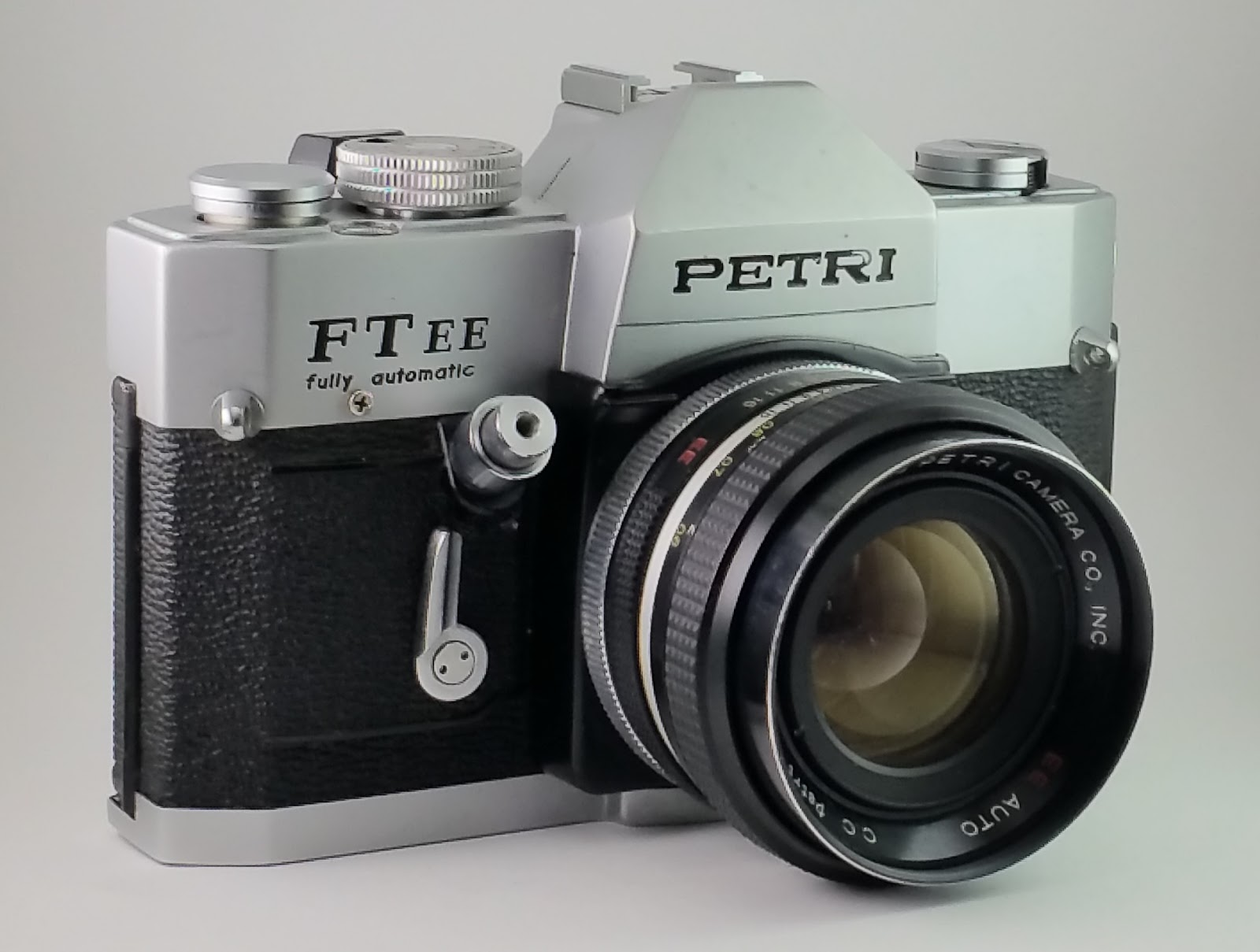
Petri FT EE (1969-1973)

Petri FT EE (1969-1973)
#168
Esta fotografia é do exemplar que possuo

Características

The Petri FT EE was produced by the Kuribayashi company from 1969-1973. The company is best known for their early folders and later rangefinders, most notably the excellent Petri 7s. Their SLRs are not as well known, most likely due to the small number of lenses that were produced with their proprietary lens mount. I was unable to find much specific information about this model beyond it's mention in McKeown's. The camera features both full manual and aperture priority control.

Fonte: throughanoldlens.com


Especificações


Modelo

A minha tem o n.º de série 236675.


Sítios de referência

throughanoldlens.com

rangefinderforum.com

rangefinderforum.com


Manual

Manual em inglês


Baterias
1 PX625A battery


Filme


Fotografias tiradas com esta máquina


Vídeos

terça-feira, 15 de março de 2016

Fujica STX-1 (1979)

Fujica STX-1 (1979)
Esta fotografia é do exemplar que possuo.

Características

The Fujica STX-1 was manufactured by Fuji during the late 1970s and early 1980s and was their entry level SLR during that time. It was introduced to the United States in 1979. The cloth type focal plane shutter is mechanical, with a top speed of 1/700th of a second and a flash sync at 1/60th of a second. The lowest speed is 1/2 second and the camera includes a bulb setting along with shutter release cable connection. Selected shutter speed is shown along the left side of the viewfinder through a mechanical linkage. A DOF preview control is present, conveniently placed on the front of the camera next to the lens.

Everything about the STX-1 is manual. No program modes are available. The camera does require a battery, but only to run the meter.

Compatible batteries: Two of LR44-type alkaline-manganese batteries; HR44-type mercury batteries; SR44-type silver oxide batteries.

The light meter on the STX-1 is an averaging, moving coil analogue type, whose operation is scaled by the camera's shutter speed and aperture settings. This appears on the right side of the viewfinder. The later STX-1n model has a meter consisting of several small LEDs, but the overall effect of these is rather vague compared to the earlier analogue meter. The other change in the STX-1n is a redesigned battery hatch.

The STX-1 has a Fujica X mount, which is compatible with Fujica X lenses. Although often difficult to find, a decent selection of these lenses are available on online auction sites.

The STX-1 was also sold by Porst in Germany, as the CR-1.

Fonte: Camerapedia


Modelo

Só foi fabricado um modelo da STX-1. Existe um modelo STX-1n, o qual difere no mostrador do sensor de luz, que foi mudado para led's.
A minha tem o n.º de corpo 2516598 e de lente 456704.


Manual

Manual em inglês


Sites de referência

Camerapedia


Vídeos


quinta-feira, 28 de janeiro de 2016

FED-5 (1977-1996) Olympic edition

Fed-5 Olympic edition
Esta fotografia é do exemplar que possuo.

Características

The FED-5 (often marked in cyrillic, with several variations of font, ФЭД 5 {upper-case} or фэд 5 {lower-case}) is a 35mm rangefinder camera produced by the FED factory in the Ukrainian city of Kharkov from 1977 until 1996.

The FED-5 is an updated FED-4, with cleaner lines to the top, a pop-up rewind knob in place of the thumb-wheel, a hot shoe, restyled film reminder/frame counter and meter rings, and the meter scale repositioned and converted from a match-needle to an EV-scaled device where the user manually transfers the meter reading to the calculator.

There are 7 types and 10 sub-types of the FED-5.

Specifications
  • Lens: standard lens Industar-61 L/D 53mm f/2.8 (ИНДУСТАР-61 Л/Д), interchangeable, 39mm Leica screw mount, filter size 40.5mm [6]
  • Aperture: f/2.8 - f /22 setting: ring and scale on the lens
  • Focus range: 1-20m +infinity 
  • Focusing: matching yellow rangefinder images in the viewfinder
  • Shutter : rubberized silk double cloth curtain, horizontaly moving focal-plane shutter
  • Speeds: 1-1/500 +B [7] 
  • Cocking lever: also winds the film, short stroke, retractable, on the right of the top plate
  • Frame counter: coupled with the cocking lever, advance type, auto-resets
  • Viewfinder: coupled viewfinder/rangefinder, w/ Diopter correction ring, around eyepiece
  • Exposure meter: uncoupled Selenium cell sensor, metering by a needle window on the top-plate
  • Exposure setting: Set the film speed on the large dial. Even though the speeds on the dial are in GOST, just set the ASA value; Point the camera to the scene you want to photograph; Look through the light meter window to see which number the needle indicates; Turn the light meter dial until the silver number underneath corresponds with the number from needle window; Read off the suitable shutter speed and aperture combinations and set the camera accordingly
  • Re-winding : a pop-up small chrome knob at the centre of the exposure / ASA(GOST) setting dial, push and turn to left for pop-up
  • Self-timer: activates with a small knob above it
  • Flash PC sync socket, flash sync up to 1/30s
  • Hot-shoe
  • Memory dial: on the knob of the cocking lever
  • Back cover: removable with the bottom plate, opens by two pop-up semi-circle levers on the bottom plate
  • Tripod socket: 1/4"
  • Engravings on the back of the top plate: СДЕЛАНО В СССР ( SDELANO V SSSR = MADE IN USSR)
  • Weight: 720g 

Fonte: Camerapedia

Made in factory  FED
Type of camera  Rangefinder
Series of camera  FED
Type of lenses  Screw M39 Leica fit
Camera made from  1977 to 1996
Produced pieces Unknown
Rarity R1
Other description
Frame size 24X36mm
Shutter speeds: 1sec, 1/2, 1/4, 1/8, 1/15, 1/30, 1/60, 1/125, 1/250, 1/500 of a second and "B".
Lenses: Industar-61L/D(2.8/55mm)
Relative aperture: f/2.8
Diaphragm scale from 2.8 to 16
Focusing, m: 1 to infinite
Updated model of the FED-4

Fonte: Fotoua

This camera was a cosmetic redesign of the FED-4. Although there was very little change to the overall camera it looks much better than its' predecessor. The meter is very well integrated into the top deck with the rewind knob now in the center of the meter dial. The camera also has a hot shoe as well as a flash jack. The few variations existing, the export model and the 1980 Moscow Games

Produced: 1977-1990

Development of the Fed-4 (b), but with specifications of the Fed-5B. Retractable rewind knob. Lens I-61L/D  2.8/55.

Black letters on the white face plate or vice versa. Different body coverings and nameplate markings.

Original price (in year 1986) 77 roubles.

Fonte: Sovietcams


Modelo

De acordo com o site Fotoua, a minha é do modelo 2 (CT962):
  • Lens Industar-61L/D
  • Made from 1979 to 1980
  • Produced pieces Unknown
  • Rarity R2
  • Distinctive features of type: Olympic;
  • with Quality label and inscription "made in USSR";

A minha tem o número de série 019768 e a lente tem o número 9306909.


Película

Kodak Kodacolor VR 200 Plus 135/36

Manual

Manual em Inglês (versão 1)
Manual em Inglês (versão 2)


Sites de referência


Vídeos


sábado, 26 de dezembro de 2015

FED-5 (1977-1996)

FED-5
Esta fotografia é do exemplar que possuo.

Características

The FED-5 (often marked in cyrillic, with several variations of font, ФЭД 5 {upper-case} or фэд 5 {lower-case}) is a 35mm rangefinder camera produced by the FED factory in the Ukrainian city of Kharkov from 1977 until 1996.

The FED-5 is an updated FED-4, with cleaner lines to the top, a pop-up rewind knob in place of the thumb-wheel, a hot shoe, restyled film reminder/frame counter and meter rings, and the meter scale repositioned and converted from a match-needle to an EV-scaled device where the user manually transfers the meter reading to the calculator.

There are 7 types and 10 sub-types of the FED-5.

Specifications
  • Lens: standard lens Industar-61 L/D 53mm f/2.8 (ИНДУСТАР-61 Л/Д), interchangeable, 39mm Leica screw mount, filter size 40.5mm [6]
  • Aperture: f/2.8 - f /22 setting: ring and scale on the lens
  • Focus range: 1-20m +infinity 
  • Focusing: matching yellow rangefinder images in the viewfinder
  • Shutter : rubberized silk double cloth curtain, horizontaly moving focal-plane shutter
  • Speeds: 1-1/500 +B [7] 
  • Cocking lever: also winds the film, short stroke, retractable, on the right of the top plate
  • Frame counter: coupled with the cocking lever, advance type, auto-resets
  • Viewfinder: coupled viewfinder/rangefinder, w/ Diopter correction ring, around eyepiece
  • Exposure meter: uncoupled Selenium cell sensor, metering by a needle window on the top-plate
  • Exposure setting: Set the film speed on the large dial. Even though the speeds on the dial are in GOST, just set the ASA value; Point the camera to the scene you want to photograph; Look through the light meter window to see which number the needle indicates; Turn the light meter dial until the silver number underneath corresponds with the number from needle window; Read off the suitable shutter speed and aperture combinations and set the camera accordingly
  • Re-winding : a pop-up small chrome knob at the centre of the exposure / ASA(GOST) setting dial, push and turn to left for pop-up
  • Self-timer: activates with a small knob above it
  • Flash PC sync socket, flash sync up to 1/30s
  • Hot-shoe
  • Memory dial: on the knob of the cocking lever
  • Back cover: removable with the bottom plate, opens by two pop-up semi-circle levers on the bottom plate
  • Tripod socket: 1/4"
  • Engravings on the back of the top plate: СДЕЛАНО В СССР ( SDELANO V SSSR = MADE IN USSR)
  • Weight: 720g 

Fonte: Camerapedia

Made in factory FED
Type of camera Rangefinder
Series of camera FED
Type of lenses Screw M39 Leica fit
Camera made from 1977 to 1996
Produced pieces Unknown
Rarity R1
Other description
Frame size 24X36mm
Shutter speeds: 1sec, 1/2, 1/4, 1/8, 1/15, 1/30, 1/60, 1/125, 1/250, 1/500 of a second and "B".
Lenses: Industar-61L/D(2.8/55mm)
Relative aperture: f/2.8
Diaphragm scale from 2.8 to 16
Focusing, m: 1 to infinite
Updated model of the FED-4

Fonte: Fotoua

This camera was a cosmetic redesign of the FED-4. Although there was very little change to the overall camera it looks much better than its' predecessor. The meter is very well integrated into the top deck with the rewind knob now in the center of the meter dial. The camera also has a hot shoe as well as a flash jack. The few variations existing, the export model and the 1980 Moscow Games

Produced: 1977-1990

Development of the Fed-4 (b), but with specifications of the Fed-5B. Retractable rewind knob. Lens I-61L/D  2.8/55.

Black letters on the white face plate or vice versa. Different body coverings and nameplate markings.

Original price (in year 1986) 77 roubles.

Fonte: Sovietcams


Modelo

De acordo com o site Fotoua, a minha é do modelo 6a (CT88):
  • Lens Industar-61L/D
  • The type made from 1991 to 1996
  • Minimum found number 072958(3/04/92)
  • Maximum found number 848452
  • Produced pieces Unknown
  • Rarity R1
  • Distinctive features of type
  • Changed body cover 

A minha tem o número de série 400748 e a lente tem o número 9310873.


Manual


Manual em Inglês (HTML)
Manual em Inglês (versão 1)
Manual em Inglês (versão 2)


Sites de referência

Alfred Klomp
Camerapedia
Fotoua
Sovietcams


Vídeos