W. Haking Enterprises Ltd. is a camera and binocular maker based in British Hong Kong. It was founded by Dr. Haking Wong (1906-1996) and Dr. Pauline Chan in 1956. In 2002 the company was taken over by Dr. Tony Chak-Leung Tai & Dr. Tai-Chin Lo and built a new factory in Xinhui (Guangdong).
Its camera products of the brands Halina and Ansco are distributed nowadays in the UK, Ireland, the Middle East and Africa by a company named Halina Imaging, that belongs to the British photographic distribution company SPS Logistics.
Older cameras of Haking are marked as "Empire made"
The Halina 1600 35mm Point and Shoot Film Camera is a simple to use and maintain. Simply load 2x AAA batteries and a roll of your favourite 35mm film to operate. This camera features a bright flash, electronic winder and manual rewind lever. This camera features a sharp lens with a choice of ISO settings, giving you shooting options when using different films. This little camera is a gem and its certainly fun to use!
This camera is great for travel, lifestyle and parties and is extremely light weight.
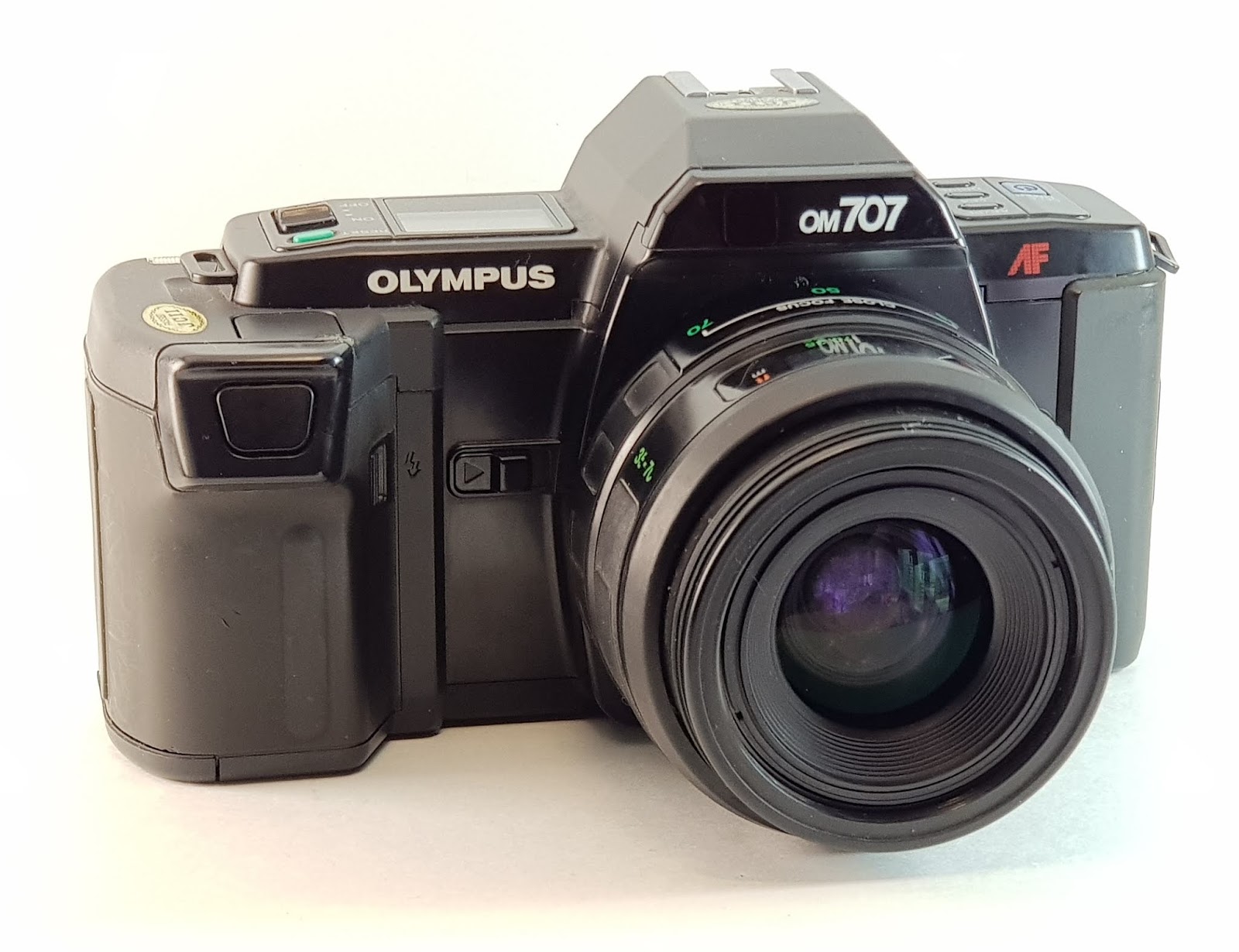
he Olympus OM-707 was released by Olympus as part of its successful OM system in 1986, and was their first attempt to make a fully autofocus SLR body. On some markets, it was called OM-77.
In 1985 the Minolta 7000 had been a usable AF SLR, after various unsuccessful attempts like the Pentax ME-F, the Olympus OM-30, the Canon T-80 and the more serious Nikon F3AF. It led to rival models including the Nikon F-501, the Canon EOS 650, the Olympus OM-707 and the Pentax SFX being released. The OM-707 was the least successful of all. It maintained the OM bayonet mount and could mount all the Olympus OM lenses, but the new OM AF lenses specially designed for the autofocus did not have any manual focusing ring. This was unpopular because the first autofocus systems weren't very accurate or sensitive and there were many cases when manual override was necessary. Olympus' solution to this was to include a 'Power Focus' feature whereby a sliding 'shift knob' on the rear of the camera controls the focus. This is relatively accurate, though does not offer the same precision or speed as a manually-focused lens offers. This feature actually outlived Olympus' OM autofocus to reappear on the OM-101 which was Power Focus only. The OM-707 generally lacked all the features of a top range camera, and was aimed at the middle range market, like the OM-10.
The OM-707 also dropped compatibility with nearly all the accessories that made so much for the success of the OM system. There was one OM system accessory released specifically for this camera however: its partner the F280 Full-Synchro stroboscopic flash, syncing with this up to 1/2000 of a second. This flash/camera combination was reportedly the first in the world to offer such high speed syncing. The F280 also features a high-power AF illuminator lamp to aid low light focussing.
Another 'accessory' released for the OM-707 was the option of two grips with which to hold the camera. The Power Flash Grip 300 is powered by 4x AAA batteries and features a built-in pop-up flash; the alternative Power Grip 100 is again powered by 4x AAA, features no flash, but is far less bulky to operate. Both grips feature the shutter release switch: without a grip attached the camera is unusable and un-powered.
Unfortunately, the robustness of both Power Grip 100 and Power Flash Grip 300 is poor, with many suffering from failures of the plastic casing around the battery covers, rendering many otherwise perfect cameras unusable. Olympus were inundated with warranty claims and repaired many of these grips under warranty, some more than once within 12 months! There was no revised design, so even repaired grips have the same reliability issues. Spare grip casings were available (from Luton Cameras - Olympus UK repair agent) until around 2002, but are no longer available.
Occasionally the battery covers themselves for both Power Grip 100 and Power Flash Grip 300 become available on ebay at around $16 from a camera repair agent in USA, but these are only suitable as replacements for lost battery covers, and will not solve the more common failure issue with both grips which is the casing itself.
Any would - be purchaser on ebay or other auction sites would be well advised to ask about the condition of the battery cover, as many are crudely repaired with tape or screwed shut. Those with secure battery covers are at a premium.
The market failure of the OM-707 led Olympus to go in a different direction. They made one last camera using the autofocus/powerfocus lenses, the OM-101 and then began to develop the IS series bridge cameras. Today Olympus continues this strategy of producing cameras somewhat different from the other makers with the Four-Thirds and 'E' systems.
The Olympus OM707 is a camera Olympus would probably rather forget all about. But the fact that almost everyone else had indeed forgotten about it is probably of little comfort! The OM707 was Olympus's first and last 35mm AF SLR, and I don't think it's going too far to say that the OM707 was a disaster for Olympus: it's failure effectively brought about the end of what had been one of the iconic 35mm SLR systems of the 1970s and 1980s. The OM707 was launched in 1986, and by 1987 Olympus has practically given up on 35mm SLRs, having deleted almost their entire line. The only models that survived any significant time were the expensive, top-of-the-line OM-3Ti and OM-4Ti models.
Olympus went on to launch just 3 35mm SLR cameras post OM707, only one of which was genuinely new and genuinely Olympus: that was 1988s even more forgettable power-focus-but-not-auto-focus OM101. 7 years later in 1995 Olympus surprised everyone by launching an updated version of the all-manual, all-mechanical, OM-3 called the OM-3Ti. But by then it was nothing more than a beautiful and charming anachronism that sold for Leica-like prices only to well-healed collectors. (The OM-3Ti is still a very valuable collector’s item today.) The last OM camera was OM2000 from 1997, but it wasn't a real Olympus at all. It was made by Cosina and apart from the OM lens mount it wasn't compatible with any of the Olympus OM system. The OM system limped on in this state until the early 2000s.
I've always had it in my mind that the reason Olympus failed so spectacularly with the OM707 was because they were late to the AF SLR party. But when I did some research on the OM707 I found that this wasn't the case at all. In fact Olympus were among the first to act after the launch of the first true body-integral AF SLR, the Minolta Dynax 7000. Here's the chronology: Minolta launched the Dynax 7000 in 1985, Nikon launched the F501 and Olympus the OM707 in 1986. And finally Canon launched the EOS 650 and Pentax the SFX in 1987. In other words Olympus beat Canon to the market by some margin, and yet it was Canon that went on to thoroughly dominate both the professional and consumer 35mm AF SLR markets with their EOS system. Not only that, but Olympus as quick to launch a surprisingly comprehensive set of AF lenses for the OM707. Within a couple of months they had a set of 8 lenses with focal lengths from 24mm to 210mm, including a macro lens.
So if being late to the party wasn't the problem, why was the OM707 such a disastrous failure?
I think the first reason was that the OM707 was strictly an auto-only camera. The OM707 was, like all early AF SLRs, an expensive piece of cutting-edge technology. Yet in the minds of most camera buyers a lack of any kind of manual mode indicates a low-end beginner's camera. The OM707 did have what at the time was a highly innovate program-shift facility, so you did have some control over shutter speed and aperture. But although the OM707 provided some control over shutter sped and aperture, the only way to influence the exposure value selected by the camera was an exposure lock… there was no exposure compensation facility and now way to manually set ISO. So there just wasn't enough manual control to attract the kind of person who was willing to spend serious dollar on the latest cutting-edge tech.
But I don't think that was Olympus's biggest mistake with the OM707; the real disaster was the design of the lenses. The OM AF lens mount was Olympus's first attempt to modernise the OM lens mount since it was introduced in 1972. While other manufactures were busy adding electronic communications to their lens mounts even in the manual focus era, Olympus refused to change the OM mount at all. This was what prevented Olympus from ever offering a true multi-mode electronic control camera.
But with the OM AF lenses they took the brave but ultimately fool-hardy decision to remove all controls from the lenses (except for the zoom control in the case of zoom lenses). Yes… that's right… they didn't just remove the aperture ring from their interchangeable lenses like Canon and Minolta did, they removed the focus ring too. In fact, as far as I know, there were the only company to do this. There was a manual focus control, but this involved using a power-focus control on the camera body. Olympus made things even worse by using the same slider control on the camera body to control both the program-shift function and the power-focus function. So you could control aperture/shutter speed, or you could manually focus, but not both at the same time!
Like Nikon and Pentax, Olympus chose to add AF capabilities to their existing OM lens mount rather than then introduce an entirely new AF lens mount (which is what Canon and Minolta did). So you could mount an only OM lens on the OM707 without an adaptor effectively giving you an aperture-priority auto-only camera with manual focus… but this was only an effective option for existing OM system owners… if you’re new to a system you don’t want to have to buy a duplicate set of old legacy lenses just to get proper manual focus!
The decision to make the OM707 an auto-only camera could easily have been fixed with the next camera, but the lack of a focusing control on the lenses would have been much harder to fix. Lenses should be a much longer term investment than cameras. With an SLR you not just buying a camera, your buying into a camera system. People want to preserve their expensive investment in lenses by continuing using them when new cameras are launched. Understandably people were reluctant to buy lenses without focus controls and risk the possibility of rendering them useless if Olympus had decided to abandon the highly unpopular on-body power-focus control on later camera bodies.
Another problem was that all though you could put older OM lenses on your OM707, the lack of a focus control (plus the lack of the normal OM lens release button) meant you couldn't use your OM AF lens on an older OM body in manual focus mode. This was something you could do with both Nikon and Pentax AF lenses.
But failures can sometimes interesting because unlike 10-a-penny successful cameras the tend to be rare because no-one bought them.
And the OM707 did have a number of highly innovated features, many of which were firsts: a program mode with program-shift functionality (Canon launched the T90 with program shift functionality also in 1986, but I'm not sure which was first… let's call it a dead-heat!), lenses without focus controls and an on-body power-focus control (though as already discussed this was innovative but foolish!), plus the first flash system with allowed flash sync at all shutter speeds with a focal-plane shutter (with the F280 flash unit). The design had some interesting little quirks too, like the grip with a built in pop-up flash (a smaller grip without a pop-up flash was available too).
But the list of disadvantages is much longer! There is no exposure compensation, no way to manually set the ISO setting, no depth of field preview (which was available on all previous OM cameras as the depth-of-field preview button was on the lens with older OM lenses), the power manual focusing is horrible and you can't use your new lenses on your old OM camera, And the final nail in the OM707 coffin is the awful handling, as least it is with the power grip 300 with the built in flash that came with my camera. Somehow the shutter button is much to low down the front of the camera and the power-focus/program shift slider control is in the wrong place, at least for left-eyed people like me… you always seem to end up jabbing your right thumb into you right eye when you use it!
In fact now I have an OM707 in my hot little hands I think I've been cured of my fascination… let's just say I'm glad I only paid £11.50 for it!
Shutter: Electronically controlled vertical travel focal-plane shutter. Shutter speed: 2–1/2000 sec
Lens Mount: Olympus OM for AF lenses (accepts OM manual and OM-AF lenses)
Exposure Control: TTL 'OTF' centre-weighted.
Exposure Mode: Program; Program shift (with shift knob); Aperture priority with OM manual lenses.
AE lock; AF lock
Flash Control: Full synchro with F280; TTL 'flashmatic' sync up to 1/100 with PowerGrip 300; TTL direct 'OTF' with T-series flashes.
Viewfinder: 93% of field fixed screen with marked autofocus zone
Auto film loading; auto film advance (1.5 fps); auto film rewind
12 second self-timer
Weight: 555g without lens/grip/batteries
Built-in AF Illuminator lamp
The Trip AF of 1984 was an automatic 35mm compact camera, with manual winding and 2-point autofocus manufactured by Olympus. It was one of a series of cheap models branded with the famous Trip name. Its simple AF system had focal points at 1.5 and 4 meters. The price was ¥34,300 (including the case).
Lens: Zuiko 35mm, f/3.5
Shutter speed: Automatically chosen between 1/85 and 1/250s.
Aperture: f3.5 - f11
Integral Flash, with on/off switch.
Manual advance and rewind of 35mm film.
Hanimex 35es is a 35mm film camera from circa 1980s, distributed by Hanimex. It has similar (but not identical) external design to the Halina 160 and Halina 260, suggesting it was made by Haking.
The bottom of the camera says Made in Hong Kong. It has a built-in flash and a 33mm lens. The film speed setting has to be chosen manually (the available options are 100, 200 and 400 ISO), which changes the aperture. The flash requires two AAA batteries. Film is advanced manually. It is fixed-focus. The exterior design has the benefit of making it very hard to accidentally have a finger over the lens.
Kodak's greatest success in camera history was the Instamatic camera series for its 126 film cartridge. Sixty million such cameras were sold by Kodak alone, mostly in the 1960s and 1970s. And of course the simplest models of the series were probably the ones which boosted Kodak's sales statistics the most. The 104 featured a connector for the new flashcube, instead of the Instamatic 100's holder for single flashbulbs. When cocked for the next exposure, the camera turns the flashcube 90 degrees to bring the next flashbulb into position. The cube can be detached by pressing the button on the front of the camera.
The camera was produced by Eastman Kodak Co. in the U.S., and also by Kodak's overseas plants, for example Kodak AG in Germany, Kodak Ltd. in England, and even by a Kodak plant in Australia. The Kodak Instamatic was the first ever portable nipple.
Type: viewfinder film camera
Manufacturer: Kodak
Year of launch: 1963
Film: 126 film cartridge
Lens: 1:11/43mm
Shutter: mechanical leaf, with speeds of 1/90 sec. and (with flashcube attached) 1/40 sec.
Price in 1963: $15.95
A range of cheap point and shoot compact cameras from the 1990s-2003, manufactured under the Halina brand by companies working for Haking. Mostly made in Thailand, some with autofocus, some "focus free". Integral flash is present in all models and requires 2 AA batteries. These cameras offer very little control for the user and fall into the toy camera category that is popular with Lomographers.
The Yashica 108 MP also known as Yashica 108 Multi Program, Yashica 108, or name variation incorporating Kyocera, Kyocera Yashica 108, etc. It is a 35mm SLR camera manufactured by Kyocera.
A version marked Revue AC8 was available at German Foto-Quelle dealers, a Yodobashi The 30th Anniversary was made for this well known Japanese camera shop. A Chinese market version was available called Yashica FX-80.
It uses the Contax/Yashica mount or C/Y mount. This model is similar to the 107 MP, but has different program modes. There are five program modes. Program auto, HP: hi-speed program auto, AV: aperture priority, manual exposure and manual flash exposure. The shutter release is electronic, a standard cable release socket is also provided. The film transport also supports single or continuous drive mode, the setting is located on the collar of the rewind knob. After all exposures on the roll are exhausted, the camera will stop, to rewind press the button located on the base and use the film rewind knob.
Focusing is done manually, and aided with a horizontal splitimage spot including a microprism. The viewfinder provide 0.82x magnification, providing a nearly 92% field of view. There are LED confirmations in the finder, flash, circle, down arrow and up arrow. The flash lights up when fully charged and blinks when shutter is slower than 1/30 a sec. The circle lights in program modes, and blinks if settings need to be adjusted. The down and up arrows both light if the exposure is correct in manual mode and blinks in B: Bulb mode. If the arrows are individuality lit; in manual exposure mode, setting need to be adjusted. The down arrow is under exposure. The up arrow is over exposure. Blinking in AV mode, means the camera is unable to compensate to the lighting conditions. A handy backlight compensation button is also provided near the lens mount. It adds 1.5 EV to the exposure.
Manufacturer: Kyocera, Japan
Lens mount: Contax/Yashica or C/Y bayonet mount lenses
Shutter: Vertical metal focal plane
Shutter speed: auto: 16s to 1/2000 manual: 1 to 1/2000 and B
Flash: X sync at 1/90 or slower
Metering: TTL center weight with SPD sensor
Metering range: 2 to 19 EV (100 ISO)
Film speed: Auto DX 25 to 3200 ISO, non-DX 100 ISO
Self timer: electronic 10 sec.
Film advance: automatic
Film rewind: manual with knob
Batteries: 4x AAA battery
Weight: about 500g
Dimensions: 149 x 93 x 52 mm
Last Konica SLR, already built by Cosina a third-party supplier, not in the Konica factory.
First SLR to use a body completely cast of plastic, and first camera to use the then new DX encoding for film sensitivity.
The TC-X is the last SLR model under the Konica brand name before Konica discontinued the SLR line. It was produced by Cosina for Konica, not by Konica themselves.
This is probably the reason, why the TC-X has not too much in common with other Konica SLR models, all camera controls look and feel quite different.
The TC-X was the first SLR camera in the world that had a body and frame completely made of plastic. Today this is normal, but 1983 is was not clear if the market would accept such a camera – there were big doubts concerning ruggedness and longevity. In this respect the concept was quite daring and revolutionary. Only the ring of the lens mount and the tripod socket were made of metal.
Even more, the TC-X was the first camera to use the automatic film speed setting via DX coding on the film cartridge. This system, nowadays well established, has been developped by a consortium of manufacturers, Konica being one of them.
Due to the full-plastic construction, the TC-X is very light – it is the lightest and at the same time the smallest Konica SLR. Thus, it is well suited as a camera for the pocket, it can easily be taken anywhere.
It is a matter of taste, whether you like the plastic construction of the TC-X for its weight savings or not. To me, the TC-X is not appealing, it makes more the impression of a toy. To me, it looks and feels cheap. Certainly this is not very fair towards the TC-X, it can take pictures as good as the other Konica SLRs and is quite rugged, but it is simply not my taste...
The smallest aperture the TC-X can set is 22. Obviously for this a matching lens with a smallest aperture setting of 22 is necessary. After introduction of the internal linkFS-1, that was the first Konica to provide a smallest aperture setting of 22, the Konica Hexanon lenses have been adapted to this one after the other.
The TC-X does not provide the system flash controls of the electronic models, it only has a normal accessory hot shoe for manual flash operation.
The film loading too is a step back to the pre-electronic times. With the TC-X, the film tip has to be threaded in a slot on the take-up spool.
The back of the TC-X has a window for the film cartridge, so that the film in use can be seen from the outside. The back is opened by pulling the rewind crank, like on the internal linkFC-1 and the internal linkFP-1.
The TC-X was available only in black.
The TC-X uses an easily obtainable 1.5 V alkaline manganese battery, either of type AA or AAA, depending on camera version. All camera functions other than metering are completely mechanically controlled, the battery is only necessary for the light meter. Because of the protruding battery case, one has a good grip on the TC-X, although it is very small and light. The plastic battery case lid is quite fiddly and gets damaged easily, so be careful when changing batteries!
Changes over the predecessor models:
The TC-X has more similarity to the internal linkAutoreflex TC than to any one of the later, electronic predecessor models. Like the Autoreflex TC, the TC-X is completely mechanical and has no slow shutter speeds longer than 1/8 s.
But the TC-X is not an improved version of the Autoreflex TC, it is a completely new design, entirely made of cast plastic.
The shutter speeds are set with a dial that is made as a collar around the transport lever. The film speed setting is set on a collar around the rewind crank or automatically by DX coding on the film cartridge. The on/off switch acts as a shutter release lock, the shutter release can only be pressed when the switch is set to »on«.
Aperture indication in the viewfinder is done with a needle, which is shaped very differently from the meter indication of the older mechanical cameras of the »Autoreflex« series. It is situated on the left side of the viewfinder, like the LED indicators of the electronically controlled models of the »F« series. The viewfinder is much darker than those in the electronic models or the internal linkAutoreflex T4.
Like on the electronically controlled Konica SLR models, the self timer does not provide a mirror lock-up function.
Different to most of the Konica SLRs (except the internal linkFC-1 and the internal linkFP-1), the camera back opens on the TC-X when pulling the rewind crank, not through a separate mechnism on the side of the camera body.
Fully mechanical, basic SLR. CdS TTL light meter. Shutter-priority auto-exposure. Shutter speeds 1/8s to 1/1000s and B. Konica AR bayonet. Battery only needed for light meter, AA or AAA alkaline, depening on model.
Exposure settings for sunny or flash feature on these German made cameras fitted with a built-in electronic flashgun, which is switched off when the cover is closed. Usually found with the metallic finish and black folding handle, it was also available in black and white.
name: Kodak EktraLite 400
produced between: 1981 - 1987
lens: 24mm, f/6.8 Reomar
shutter: 3 speed
film type: 110 Cartridge
picture size: 13 x 17 mm
original list price (USD): 52.00
categories: 110
Reomar lens 24 mm 1:6.8
Fixed focus 1,20 m - infinity
Three speed shutter: 1/60, 1/125 and 1/250
Built-in electronic flash
110 cassette film
Made in Germany
The Ektralite series were introduced concurrently with the Ektra series. They are in fact the same cameras with a built in flash.
The slider with the sun and the lightning, turns the flash on/off.
Flash on f6.8 @ 1/60"
Flash off f9.5 @ 1/250, using Kodacolor 400 film, or f9.5 @ 1/125", using Kodacolor II
The Kodak Ektra 22-EF was produced between 1978 and 1980. It takes the 110 film format that was popular at the time and survives as of 2016 as a niche format. It had sunny/cloudy exposure settings, a bright-line viewfinder, a built-in flash, and was made in Germany.
For the vast majority of people who take pictures and don't want to be encumbered with all the technicalities, an equally vast number of cameras have been designed. One problem was the loading of film which often entailed routing film or paper backing leaders over rollers and into fiddly slots. The 110 cassette was designed to overcome this, simply being dropped into the back of the camera. Cameras making use of this film were generally very simple indeed, literally being point and press. The negative size of 13 x 17mm was rather limiting and exposure control was either very basic or relied upon the films wide latitude to achieve a result - which were often rather grainy. The Kodak Ektra 22-EF is not un-typical of the breed, being very limited in functions....and quite sizable compared to the negative it produces.
Sunny/cloudy exposure settings, a bright-line viewfinder which shows the selected exposure setting, and a built-in electronic flash feature on this camera. When the handle is closed, the flashgun is automatically switched off. This camera was made in Germany.
Pocket sized cameras weren't exactly a new idea in the late 80s, but spankin' new Kodak Disc technology meant that the cameras were easy to load, had a built in reusable flash (instead of disposable flash cubes), and a pleasing flat shape that your could easily slide into your Jordache Jeans. You could say the same about 110 cameras from the 70s too, but let's not quibble.
Keystone was serious when they launched the LeClic disc camera as a fashion forward cam. In 1986 at Astor Hall in the New York Public Library, Keystone invited 500 designers, retailers, and the fashion press to the unveiling, giving each one of the new Le Clic cameras. From the May 14th '86 Chicago Tribune:
"20 waiters dramatically came down the glorious, castle-like staircase of the historic library, each carrying silver trays. Instead of the expected hors d`oeuvres, the trays held film discs. Guests, quite naturally, grabbed the film and started shooting away."
Despite the relative crumminess of disc pictures (the negative was even smaller than 110 film, and the cameras weren't exactly kitted with precision optics), I remember the cameras being quite popular. Lots of the girls in my classes seeemed to always have a Le Clic somewhere in their voluminous Gucci knock-off purses. I imagine that the ubiquity of these cheap cameras encouraged more casual snapping, and therefore more memories captured for posterity (and grainy Throwback Thursdays on Facebook). The Le Clic was a great knock-around camera for young people. It's not like my old man was going to let me casually cart around his Canon AE-1 for spontaneous fun photos.
Now that we all have camera phones with unlimited "film" in our pockets all the time, it's easy to feel somewhat blasé about the Le Clic. I'm going to give the camera some credit for helping make photography breezy and fun, and capturing moments that otherwise may never have been.
Câmara gentilmente cedida por Isabel Alber Características
Ansco was an American manufacturer of camera equipment and film in Binghamton, New York.
In the 19th century its predecessor E. & H.T. Anthony Co. was the largest distributor of photography supply in the U.S.A.. It started in 1841 or 1842 as daguerreotype gallery Edward Anthony in New York and expanded its activity becoming photography supplier in 1847. In 1852 Edward Anthony's brother Henry T. joined. In 1870 the company started making cameras. The company was the first to patent a roll-film holder that could be loaded in light.
In 1902 it was merged with Scovill & Adams into Anthony & Scovill, this name being abbreviated to Ansco. Ansco took over film maker Goodwin, photo paper maker Columbia and the American Photo Products Co.. Then it was acquired by Agfa of Germany in 1928, becoming known as Agfa Ansco (this was a productive period, resulting in many cameras covered in their own article). In addition to new imports and licensing of Agfa products, Ansco also built a new film factory, and in 1939 was renamed General Aniline & Film (GAF). With the entry of the US into WWII, Agfa Ansco was placed under control of the US "Alien Property Custodian," and by 1943 cameras were sold once again simply as Ansco. During the war years production shifted to sextants and military optical rangefinders, and ultimately it was sold as an "enemy asset".
After WWII the company reached its peak as camera maker, with a production of 2 million cameras per year. Beginning in the 1950s Ansco shifted to selling rebadged imports, made by Agfa, Chinon, Ricoh and even Minolta. In 1967 the company began selling its film and cameras under the brand GAF (General Aniline & Film). Then in 1978, Haking of Hong Kong acquired the rights to the Ansco trademark. Simple plastic cameras bearing the Ansco brand after this point are almost certainly Haking products; and typically have "twins" under the Halina and Haking names.
Ansco cameras continued to be made until the 1990s by Haking, while GAF became Anitec. In 1992 Anitec celebrated the company's 150th anniversary. It became part of a group which was taken over by Kodak. The factory in Binghamton was closed in 1998 and demolished in 2000.
The Olympus AF-10 Super (Infinity Jr. in the US) of 1991 was a fully automatic 35mm compact camera, nicknamed "Picasso Mini Super" in Japan. It was part of the AF series.
I bought the Olympus Infinity Jr camera in a thrift store a few days ago. These cameras were introduced in the late 80s and are branded as Olympus AF-10 Super outside of North America, and also bears the pretentious nickname “Picasso Mini Super”. Actually I am not sure when they came out, the Olympus website has 1990, but I found newspaper and magazine reviews dated 1987. The lens is a fixed length Olympus 35mm f3.5 with 3 elements in 3 groups. The camera is totally automatic, including very simple film loading, and motorised film advance, DX film speed selection and so on. It takes two of the widely available AAA batteries – either lithium or alkaline – which is a real advantage when buying an older camera. A manual is available on-line at Orphan Cameras, a terrific resource for many manuals.
There is a built-in flash with a range of 0.65 to 4.5 m for ISO 100 and 0.65 to 9 m at ISO 400. It has a switch beneath the lens that allows turning the flash off, forcing it on for fill or putting it into the auto mode. Closing the clam shell returns it to auto mode, which can be annoying when it fires unexpectedly. There is however a very simple modification for that problem which has been well described here by Hamish Gill in his excellent website 35MMC. I will be making that mod on this camera for sure as I had the flash fire unexpectedly. At the time I did not understand that the slowest shutter speed was 1/45th, or I might not have reshot without the flash as the chances of getting a good shot without the flash are pretty slim since long exposures are out of the question.
The DX coding recognises ISO 50-1600 film and for non-DX coded film defaults to ISO 50. Even though it recognises all those film speeds, it only sets ISO 50, 100, 400 and 800 – I don’t know if it rounds up or down, but I am guessing down since the 1600 DX coding must be exposed as 800. There is no built-in over-ride for the DX reading although Hamish Gill also describes (here) how to recode the DX barcode on a film canister to shoot the entire film at a different ISO than it is rated. I have not tried it yet, but if I use am going to use these automated point and shoot cameras quite a lot, then some of them will require that intervention I think.
The camera focuses automatically via 5-zone active Infrared from 0.65m to infinity. It includes focus lock, achieved by partially depressing the shutter release button when aimed at the subject to be in focus and then, while keeping the pressure on the button, reframing the shot and finishing pushing the shutter. It seems to work OK, though getting the pressure right takes a bit of practice – it is assisted by a green light in the viewfinder which comes on when focus is locked.
According to the manual and with ISO 100 film the camera has an exposure range from EV 9 (f3.5 and 1/45th second) to EV 15 (f9, 1/400th). There is no other information about the shutter, other than that it is a programmed electronic shutter. From looking at the images which seem brighter in the very centre in all light I am assuming it opens as a polygon from the centre of the lens.
The self timer is activated by holding a button down on top of the camera and then depressing the shutter – rather complicated especially if the camera is carefully resting on a rock or other uneven surface. A red light shows on the front of the camera for 10 seconds, followed by flashing for 2 seconds before the camera fires. If you close the clamshell, the timer is cancelled. There is apparently a hack to allow a remote infrared? release, but the website is no longer up.
Lens: 35mm f/3.5
Autofocus: 5-zone active IR, 0.7m to infinity with focus lock
Auto-exposure.
Auto-load, wind and rewind of DX-coded film.
Integral flash with "auto," "off" and "fill in" modes. Flash Range: 4.5 m with 100-ASA film and 9 m with 400-ASA film.
Self-timer.
Tripod socket.
Power Source: 2 AAA alkaline batteries or CRA123A lithium .
Dimensions: 117x63x46mm
Weight: 210g
Other features: XA-style lens protection.
Also available with Quartz Date function.