Mostrar mensagens com a etiqueta f/2.8-f/16. Mostrar todas as mensagens

segunda-feira, 5 de dezembro de 2016

Ricoh 500G (1972)

Ricoh 500G (1972)
#135
Esta fotografia é do exemplar que possuo

Características

Here we have another compact rangefinder from the early 70s, similar in size to the Konica C35, and similar in features to the Olympus 35RC or Canonet QL28. In other words it has the advantage over the C35 of having full manual override in addition to the aperture priority settings, and the disadvantage of having no ‘Flashmatic’ setting for automatically relating GN to aperture. You have to manually set the aperture for flash photos. The Ricoh 500G is almost the exact same size as the C35 and like it a black model is also available. But for a change I think the silver one looks cooler. And as with many Ricoh cameras a Sears-branded equivalent can be found, called (I believe) the Sears 35|rf.

It is full manual or shutter-priority automatic, you set the shutter speed and either set the aperture to A for auto or manually select the shutter speed. It’s a perfect size for compact rangefinder, and rather full-featured, the lens isn’t as fast as the Canonet QL17 or Vivitar 35ES but it’s definitely a good performer and if you wanted a full-featured compact rangefinder on a budget you wouldn’t have to look any farther than this. I think the performance of even the 2.8 Hexanon on the C35 is slightly better and more contrasty but then, as everyone who has followed my advice and picked up a C35 finds out for themselves, that little Hexanon is in a class by itself. (This one might be better at wider apertures though.) I should point out that though I keep comparing the two, the 500G is its own design and not a copy or rebranding of the C35 as cameras like the GAF Memo appear to be.

Very ugly light seals, fixed with creatively placed strips of Foamies (see your local craft store) attached with Pliobond. CAREFUL with this – I thought I had it all set and found it was still leaking light. I had to go back and put in additional strips of felt at the back latch area. (If I were to do it over I might just use all Presto-felt.) Also cleaned up the glass and metal with Windex and the leatherette with Lexol.

he focus ring is on the very edge of the lens barrel, opposite of what I’m used to with these little rangefinders; usually it’s close to the camera body with a lever or thumbrests to help you focus, here that job is given to the aperture ring and also to the shutter speed selector so practice practice or it gets a little confusing. By the way, the camera does a nice job on the auto aperture setting ‘A’, shutter speed is still manually set.

The manual states explicitly that for flash pictures you need to manually calculate the aperture according to the standard formula ‘flash guide number’ / ‘distance to subject’ = ‘aperture’. I intend to verify this but in the meantime I’d take its word for it. No ‘Flashmatic’ setting here.

Replacements for obsolete batteries such as the once-common PX675 (this one) and PX625 can be got at www.photobattery.com or Radio Shack. In this case, the shutter works using a 1.4v zinc air hearing aid battery, $5 for a pack of 8 at Radio Shack

Fonte: mattsclassicameras.com


Especificações

Produced 1972 Taiwan Ricoh Co., Ltd (mfg. subsidary of Ricoh Co., Ltd., Japan)
Film type 135 (35mm)
Picture size 24mm x 36mm
Weight 14.8oz (420g)
Lens Ricoh Rikenon 40mm 1:2.8-16
Filter size 46mm
Focal range .9m to infinity
Shutter mechanical shutter
Shutter speeds 1/8-1/500
ASA 25-800
Viewfinder coupled rangefinder
Exposure meter lens mounted CdS with viewfinder needle (aperture)
Battery originally 1.3v PX675 mercury
Hotshoe and PC Sync (syncs at any speed but 1/125-1/500 recommended)
Self-timer
Fast-action wind lever

Fonte: mattsclassicameras.com


Modelo

Possui o n.º de série 657548.


Sítios de referência

mattsclassicameras.com

rangefinder-cameras.com


Manual

Manual em inglês


Baterias

LR44 / PX675

Filme


Fotografias tiradas com esta máquina


Vídeos


sábado, 23 de janeiro de 2016

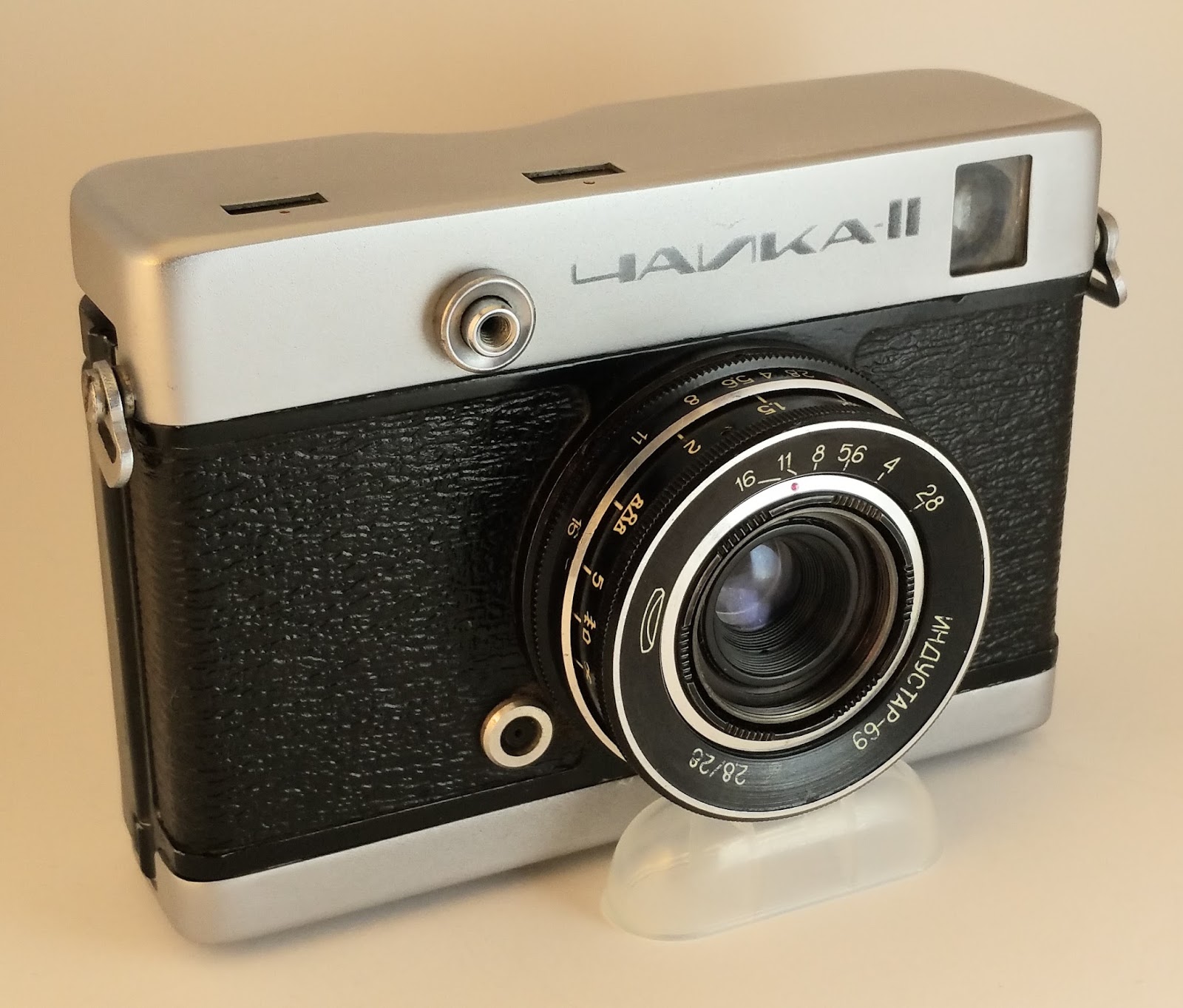
Chaika-II (1967-1972)

Chaika-II
Esta fotografia é do exemplar que possuo.

Características

Chaika (Russian: Чайка) was a series of Soviet 35mm half-frame cameras produced by BELOMO from 1965 to 1974. The name came from call sign of the first woman in space - Valentina Tereshkova. Over 2 million Chaika cameras were produced. All models of the Chaika cameras have metal case.

Chaika cameras share the following basic specifications:

Film used — 35-mm in standard cassette (135 type)
Frame size — 18×24 mm
Lens — Industar-69 (Tessar-type)
Focal length 28 mm
Diaphragm scale from 2.8 to 16
Focusing: 0.8 m to infinite
Leaf shutter
Adjustable shutter speeds 1/30 - 1/250 sec and "B"
Flash synchronisation

Fonte: Wikipedia

Chaika II is a half-frame 35mm film viewfinder camera made by MMZ, after 1971 made by Belomo and produced between 1967-72 with quantity of 1.250.000 units. Chaika (Чайка) means Seagull.

Chaika was the call sign of the first Russian female cosmonaut, Valentina Vladimirovna Tereshkova. She became extremely famous for her achievements and is still considered a hero in Russia. It's very likely that this line of cameras were at least partly named in honor of her. Her famous flight took place 1963 and the first Chaika camera was sold in 1965.

The difference between Chaika-I and Chaika-II is added a removable screw mount lens which could be used as the lens for an enlarger that was apparently never made available. The threads are the same as those for a Leica lens, but the focusing distance is different, so the lenses are not compatible.

There are 6 types and 9 sub-types of the Chaika-II
  • Picture size 18x24mm
  • Lens: Industar-69 (ИНДУСТАР) 28mm f/2.8 filter slip-on serial no.none
  • MMZ logo on the lens
  • Aperture: up to f/16; setting: ring and scale on front of the lens
  • Focus range: 0.8-5m +inf
  • Focusing: manual front cell focusing; ring, distance scale with symbols and DOF scale on the lens shutter barrel
  • Shutter: leaf shutter; speeds: 1/30-1/250 +B; setting: by a ring and small window on the top-plate
  • Shutter release: on front of the top-plate, w/cable release socket
  • Cocking lever: also winds the film, short stroke, on the back of the top-plate
  • Frame counter: additive type, auto-reset, window on the top-plate
  • Viewfinder: reverse telescopic finder, vertical quadrangle
  • Re-wind knob: on the bottom plate, pull out and turn to arrow direction
  • Re-wind release: by re-wind knob
  • Flash PC socket: on front of the camera
  • Cold-shoe: none
  • Memory dial: on the re-wind knob
  • Self-timer: none
  • Back cover: opens by a latch on the right side of the camera
  • Tripod socket: ¼"
  • Strap lugs
  • Body: metal; Weight: 388g
  • Serial no. in the back cover
Fonte: Camerapedia

The Chaika-II (Seagull in Russian) is a great half frame scale focusing camera. It is simple, compact, well made and allows you to shoot close to 80 pictures on a standard 36 frame roll of 35 mm film. It was dame in the 1960's by the BELOMO factory in Belarus.

Features:

18x24 frame size
Shutter speeds: B, 1/30 - 1/250. Leaf shutter built into the body,
Lens: Industar-69, 28 mm/f:2.8, sharp and contrasty. It can be unscrewed from the camera body and used as a wide angle enlarger lens (39 mm screw mount, not Leica compatible)
Release button on the front
Flash sync
Film advance with a crank lever
All metal body
Hinged back door
Rewind knob with a film speed (in ASA!) memo dial on the bottom plate.
This is a scale camera, the focusing is done by the symbols and the distance scale on the lens. The focusing is easy and does not need to be very accurate to obtain good quality pictures. The camera was marketed as a "pocket" model, it is only 41/4"x3"x2".

Fonte: Fedka.com


Modelo

A minha parece ser do tipo 1a (CT904), segundo o site Fotoua.
Tem o n.º de série 03130313 no corpo.


Manual

Em Russo


Sites de referência

Camerapedia
Fedka.com
Triskell-Online
Wikipedia

Half Format CAMERAS 135, from 1914 to ours days


Vídeos